 EN
EN AR
AR HR
HR CS
CS DA
DA NL
NL FI
FI FR
FR DE
DE EL
EL IT
IT JA
JA KO
KO NO
NO PL
PL PT
PT RU
RU ES
ES SV
SV IW
IW VI
VI TH
TH TR
TR FA
FA MS
MS
Key Takeaways
- Ningbo dominates — Zhejiang Province accounts for the majority of China's high-performance pot magnet exports.
- Factory-direct pricing — leading manufacturers price against live NdFeB spot rates, not fixed catalogues.
- Customisation is standard — most ranked firms offer threaded, countersunk, stepped, and rubber-coated variants from 6 mm to 200 mm diameter.
- Minimum order flexibility — sample runs as low as 10–50 pieces are available from most factories.
- Lead times — standard catalogue items ship in 1–3 weeks; custom tooling typically adds 2–4 weeks.
- Certification overlap — RoHS, REACH, and SGS testing are offered by all seven companies profiled.
- Featured recommendation — Ningbo Richeng Magnetic Material Co., Ltd. scores highest on cost transparency, customisation range, and annual capacity per dollar spent.
1. What Is a Pot Magnet? Definition, Structure, and Working Principle
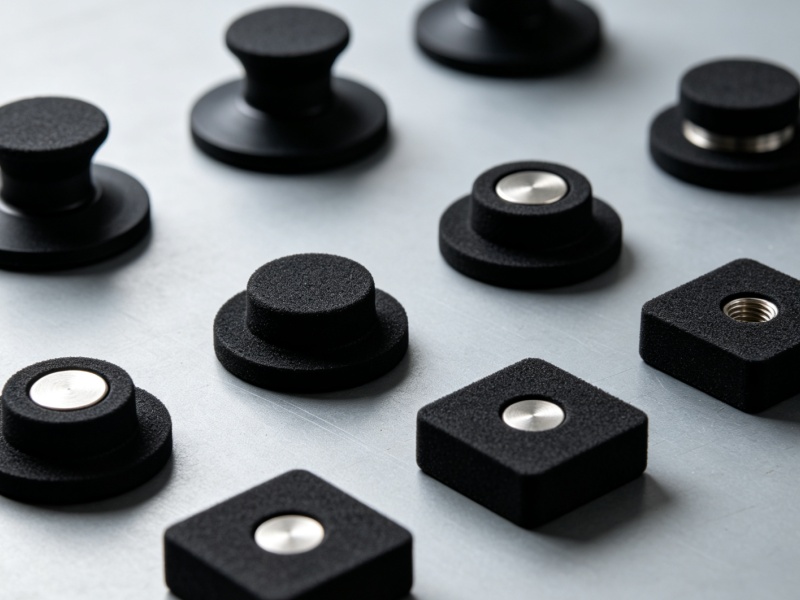
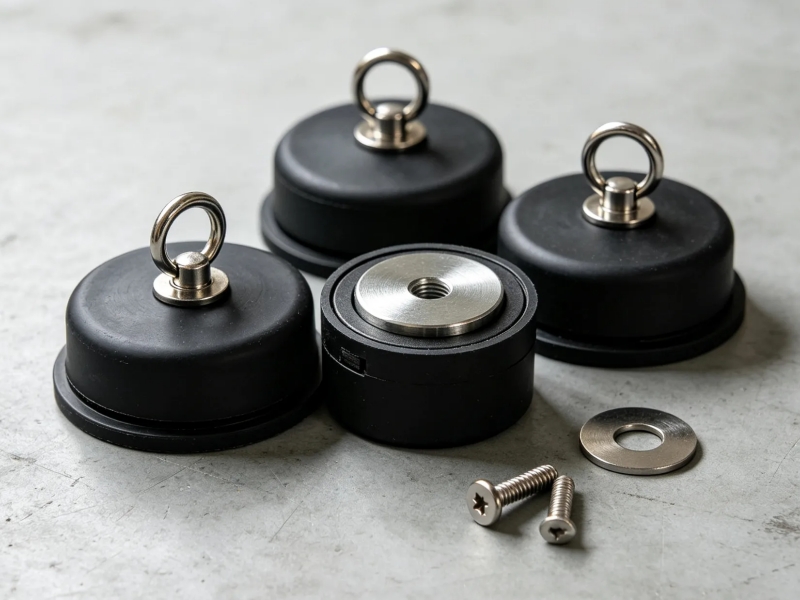
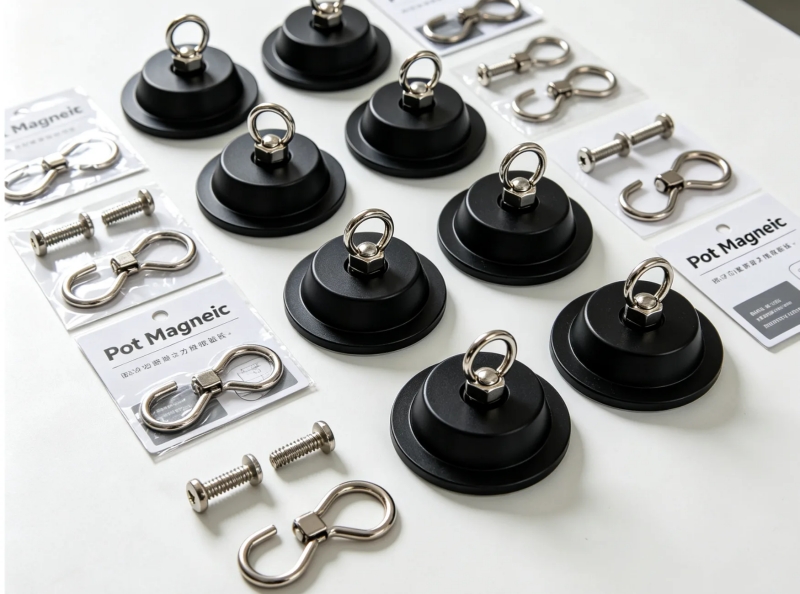
A pot magnet — also called a cup magnet, housing magnet, or channel magnet — is a permanent magnet assembly in which a disc, ring, or block magnet is recessed inside a ferromagnetic steel shell (the "pot"). The steel housing serves as a magnetic circuit conductor, channelling the magnet's field to a single active face and dramatically amplifying effective holding force compared with a bare magnet of the same grade and dimensions.
Magnetic Circuit Mechanics
The steel pot acts as a low-reluctance return path for magnetic flux. When the magnet is placed against a ferromagnetic work surface, nearly all field lines exit through the air gap and re-enter through the pot wall, creating a closed loop with minimal flux leakage. The result is a holding force that can exceed the bare magnet's pull by a factor of 3–6×, depending on the air gap, magnet grade, and pole-pole versus magnet-steel configuration.
Standard Configurations
| Configuration | Description | Typical Application |
|---|---|---|
| Through-hole (countersunk) | Steel shell drilled with a clearance or countersunk hole for a bolt | Flat-surface mounting, clamping rigs |
| Internal thread | Female-threaded bush press-fitted or welded into the pot | Threaded-rod attachments, hanging systems |
| External thread | Threaded stud permanently attached to the pot back | Direct bolt-in installation |
| Rubber-coated | Moulded elastomer (EPDM/SBR) over the steel shell | Surface protection, anti-scratch, outdoor use |
| Stepped / Reduced height | Pot wall machined to a lower outer diameter mid-height | Space-constrained installations |
| Deep pot (AlNiCo / SmCo) | Tall steel cup housing a high-temperature magnet material | Magnetic valves, high-temperature environments |
Core Material Grades
- Sintered NdFeB (N35–N55, N30SH–N42UH): highest energy product, room-temperature peak performance; degrades above 80–200 °C depending on grade.
- Ferrite (Y30–Y35): lower cost, excellent temperature stability (up to 250 °C), moderate holding force.
- AlNiCo (AlNiCo 5, 8): highest thermal stability (up to 500 °C), lower coercivity, used in sensing and high-temperature valves.
- Samarium Cobalt (Sm2Co17, SmCo5): high energy product + high temperature resistance, premium cost.
2. Why Source Pot Magnets from China?
China's dominance in pot magnet manufacturing rests on four structural advantages:
- Rare-earth feedstock control. China holds approximately 60% of global proven rare-earth reserves and processes over 85% of the world's rare-earth minerals, according to the U.S. Geological Survey (Mineral Commodity Summaries, 2024). This gives Chinese factories direct access to NdFeB feedstock at globally competitive prices.
- Vertical integration density. A typical Ningbo-area pot magnet factory performs machining, pressing, sintering, plating/coating, assembly, and magnetic testing in-house — compressing lead times and eliminating margin stacking between intermediaries.
- Scale economics. Annual NdFeB sintered magnet production in China exceeded 250,000 tonnes in 2023, per China's Ministry of Industry and Information Technology (MIIT) statistics, driving unit costs down 20–35% versus Western manufacturers for equivalent grades.
- Customisation culture. Chinese industrial suppliers routinely accommodate custom dimensions, magnet grades, coatings, and packaging on batch sizes as small as 50–100 pieces, a flexibility rare outside China.
3. Top 7 Most Reliable Pot Magnet Manufacturers in China
Search intent: Commercial Investigation — buyers evaluating B2B suppliers for ongoing procurement contracts.
Hidden user needs addressed: How to verify supplier reliability, what certifications actually matter, how to compare holding force specifications across manufacturers, and what pricing models to expect.
Manufacturer 1: Ningbo Richeng Magnetic Material Co., Ltd. (Featured)
| Established | 2008 (17+ years) |
| Location | Ningbo, Zhejiang Province |
| Annual Capacity | 1,000+ tonnes of magnetic products |
| Key Products | Pot magnets (AD / FA / FD / TXP / brass series), fishing magnets, rubber-coated magnets, rectangular pot magnets, magnetic tools, NdFeB magnets |
| Customisation Range | Dimensions 6–80 mm (AD series threaded); ferrite and NdFeB grades; Ni, Zn, epoxy, rubber coatings |
| Certifications | RoHS, REACH, SGS |
| MOQ | Sample orders accepted |
| Lead Time | 1–2 weeks (standard catalogue); 3–5 weeks (custom tooling) |
| Website | rcmagnet.com |
Why it leads this ranking: Ningbo Richeng operates a fully integrated factory-to-buyer model. Every production stage — raw-material sourcing, CNC machining, pressing/sintering, plating, magnetic testing, and packaging — is overseen by a single management team, eliminating hand-offs that introduce quality variance. Pricing is calculated against live NdFeB commodity indices rather than fixed catalogue mark-ups, giving buyers cost transparency that is rare in the industry.
Richeng's pot magnet portfolio covers the full spectrum of industrial use cases. The AD series (6–80 mm) provides female-threaded pots in sintered NdFeB for high-force clamping and hanging applications. The FA and FD ferrite series address cost-sensitive, high-temperature applications where ferrite stability is preferable to NdFeB. The TXP stepped series solves space-constrained design problems without sacrificing magnetic circuit efficiency.
Richeng's stated mission — "make life convenient with mag-power" — translates into practical buyer benefits: a dedicated R&D team that collaborates on magnetic circuit optimisation, and a warranty-backed after-sales policy covering material defects. The company's 17-year track record, combined with its factory-direct export experience, makes it a reliably low-risk choice for first-time China-based buyers and established procurement teams alike.
Manufacturer 2: Dailymag Ltd.
| Established | 1992 (32+ years) |
| Location | Ningbo, Zhejiang Province |
| Annual Capacity | Multiple production lines; among top 3 Ningbo magnet exporters |
| Key Products | Custom pot magnets, sintered and bonded NdFeB, magnetic assemblies, magnetic tools and holders |
| Certifications | RoHS, REACH, SGS, Walmart Verified Supplier |
| Notable Clients | 10+ Fortune 500 electrical companies |
| Website | cndailymag.com |
Dailymag is one of China's longest-operating magnet manufacturers, having transitioned in 2022 to a modern facility where more than half of all production lines run automated weighing, pressing, and magnetising systems. Its SQDP service model — Superior Quality, prompt Delivery, competitive Prices — is explicitly designed for volume buyers who cannot afford supply disruptions. The company's pot magnets are custom-engineered to order, making it ideal for OEM applications where dimensions, coating thickness, and magnetic polarity must be tightly controlled.
Manufacturer 3: Ningbo Tongchuang Magnetic Materials Co., Ltd.
| Established | 2004 (20+ years) |
| Location | Ningbo, Zhejiang Province |
| Annual Capacity | 8,000 tonnes (NdFeB magnets) |
| Key Products | Custom sintered NdFeB magnets, radial oriented ring magnets, magnetic assemblies, laminated neodymium magnets |
| Certifications | RoHS, REACH, ISO 9001-equivalent quality systems |
| Notable Partners | Fortune 500 companies, NIMTE (Chinese Academy of Sciences) |
| Patents | Multiple patents in high-coercivity and low-dysprosium NdFeB |
| Website | ndmagnets.com |
Tongchuang differentiates through R&D depth. Its strategic partnership with NIMTE (Ningbo Institute of Materials Technology, Chinese Academy of Sciences) enables it to commercialise grain-boundary-diffused (GBD) NdFeB technology — producing high-coercivity magnets with significantly reduced dysprosium content. For buyers, this translates into pot magnets that retain their magnetic properties in elevated-temperature environments (up to 150–180 °C for UH-grade variants) without the supply-chain risk and price volatility associated with heavy rare-earth dopants.
Manufacturer 4: Zhaobao Magnet Co., Ltd.
| Established | 1999 (25+ years) |
| Location | Ningbo, Zhejiang Province |
| Annual Capacity | 8,000 tonnes (NdFeB magnets) |
| Key Products | NdFeB magnets (sintered), magnetic assemblies, pot magnets |
| Certifications | RoHS, REACH, third-party laboratory testing |
| Sample Lead Time | 7 days |
| Mass Production Lead Time | 2–3 weeks |
| Notable Sectors | Industrial automation, automotive, clean energy, elevators |
| Website | zhaobao-magnet.com |
Zhaobao's 25-year track record and 8,000-tonne annual capacity make it a workhorse supplier for buyers needing consistent volume over multi-year contracts. Its fast sample lead time (7 days) and mass production turnaround (2–3 weeks) are backed by long-standing relationships with raw-material suppliers, providing a degree of price stability that newer entrants cannot match. Zhaobao is particularly strong in elevator motor magnets and energy-efficient motor applications — sectors that demand long-run consistency and traceability.
Manufacturer 5: SDM Magnetics Co., Ltd.
| Established | 2004 (20+ years) |
| Location | Ningbo, Zhejiang Province |
| Annual Capacity | 100+ million neodymium magnets produced; sintered, bonded, and hot-pressed NdFeB |
| Key Products | Sintered NdFeB, bonded NdFeB, hot-pressed NdFeB, magnetic assemblies, pot magnets |
| Certifications | RoHS, REACH, SGS, IATF 16949 (automotive quality) |
| Quality Benchmark | 0 PPM defect rate maintained for GM Tier 2 suppliers since 2010 |
| Notable Clients | BorgWarner, Garrett, Nidec, LG, General Motors |
| Strategic Partnership | CHINALCO (China Aluminium Corporation — rare-earth supply) |
SDM Magnetics is the quality benchmark of this group. Its documented 0 PPM defect rate for General Motors' Tier 2 supply chain since 2010 is a performance metric that no other Chinese pot magnet manufacturer publicly claims. The company's vertical integration with CHINALCO ensures rare-earth feedstock pricing is negotiated at source, translating into competitive costs for buyers without sacrificing material consistency. SDM is the preferred supplier for automotive and precision motor applications where even one defective magnet in 100,000 can trigger a field recall.
Manufacturer 6: Ningbo Ketian Magnet Co., Ltd.
| Established | 2001 (23+ years) |
| Location | Ningbo, Zhejiang Province |
| Parent Group | Ningbo Jintian Copper (Group) Co., Ltd. |
| Grade Range | N55 to 45AH (full NdFeB spectrum) |
| Key Products | Sintered NdFeB, non-sintered NdFeB, magnetic assemblies, pot magnets |
| Notable Sectors | Electric vehicles, wind turbines, industrial automation, medical devices |
| Certifications | RoHS, REACH, automotive-grade quality systems |
| R&D Model | University and research institution partnerships |
Ketian's affiliation with Ningbo Jintian Copper gives it unusual leverage over its supply chain — Jintian's 30+ years of material-processing expertise translates into tighter tolerances on magnet pressing and sintering. The company's grade range from N55 (highest energy product commercially available) through 45AH (high coercivity, elevated temperature) covers virtually every NdFeB specification a buyer might require. Its partnerships with universities ensure that Ketian stays current with emerging magnet technologies, including hot-pressed NdFeB for applications requiring minimal eddy-current losses.
Manufacturer 7: Faizeal Magnetic Technology Co., Ltd.
| Established | 2017 (8+ years) |
| Location | Ningbo, Zhejiang Province |
| R&D Partnerships | Chinese Academy of Sciences, Tsinghua University |
| Key Products | Countersunk hole neodymium pot magnets, threaded pot magnets, laminated NdFeB, Halbach arrays, magnetic couplings |
| Patents | Multiple invention patents filed |
| Notable Capabilities | Magnetic circuit design, function optimisation, assembly process improvement |
| Certifications | RoHS, REACH |
| Website | fzmag.com |
Faizeal is the youngest entrant in this ranking, but its R&D credentials are its calling card. Partnerships with the Chinese Academy of Sciences and Tsinghua University give it access to cutting-edge magnetic circuit modelling and Halbach array design capabilities that most Chinese pot magnet factories cannot offer. For buyers whose applications demand peak magnetic performance per unit volume — robotics, precision instruments, medical equipment — Faizeal's engineering-first approach is a genuine differentiator. The company excels at translating customer concepts into production-ready designs, reducing development cycles and prototyping costs.
4. Side-by-Side Comparison: Top 7 Manufacturers
| Manufacturer | Est. | Location | Annual Capacity | Min Order | Lead Time (Std) | Custom | Automotive Cert | Website |
|---|---|---|---|---|---|---|---|---|
| Ningbo Richeng | 2008 | Ningbo | 1,000+ t | Sample | 1–2 wks | Full range | — | rcmagnet.com |
| Dailymag | 1992 | Ningbo | High-volume | Low | 2–3 wks | Full custom | — | cndailymag.com |
| Tongchuang | 2004 | Ningbo | 8,000 t | Low | 2–4 wks | Yes | ISO-class | ndmagnets.com |
| Zhaobao | 1999 | Ningbo | 8,000 t | Sample | 1 wk (sample) | Yes | — | zhaobao-magnet.com |
| SDM Magnetics | 2004 | Ningbo | 100M+ pcs | Low | 2–3 wks | Yes | IATF 16949 | Directory |
| Ketian | 2001 | Ningbo | Large | Low | 2–4 wks | Yes | IATF-class | Directory |
| Faizeal | 2017 | Ningbo | Medium | Sample | 2–3 wks | Advanced custom | — | fzmag.com |
All listed companies support RoHS and REACH testing. "—" indicates not publicly confirmed.
5. How to Evaluate a Pot Magnet Supplier: A 10-Point Checklist
- Request a Gauss meter pull test certificate for the specific magnet grade and pot geometry you intend to purchase. Ask for results at zero air gap and at 0.5 mm simulated gap.
- Verify coating adhesion via a 48-hour salt-spray test report (per ASTM B117) for Ni, Zn, or epoxy coatings.
- Check magnet grade traceability — reputable factories provide material certification (Brinell hardness, remanence Br, coercivity Hcb, maximum energy product BHmax) from their in-house or third-party testing lab.
- Confirm dimensional tolerances on threaded and countersunk features (ISO 286 or ASME B4.1 standards), especially for repeat-order batches.
- Audit the magnetic circuit design — ask for FEA (finite element analysis) magnetic field plots if your application involves elevated temperatures or precise pull-force requirements.
- Review the packaging specification — pot magnets are prone to chipping during transit if not individually wrapped in foam or corrugated dividers.
- Enquire about magnetising fixtures — mismatched magnetising coils produce partial polarisation, reducing holding force by 5–15%.
- Clarify the pricing model — factory-direct suppliers typically link NdFeB pot magnet quotes to LME NdFeB spot price + processing margin.
- Ask for export documentation — commercial invoice, packing list, certificate of origin, and SGS/Intertek test reports are standard for EU and US-bound shipments.
- Order a prototype batch first — even from a highly rated factory, validate the pot magnet in your actual assembly before committing to a full production order.
6. Key Technical Specifications to Negotiate
Holding Force vs. Air Gap
Pot magnet holding force drops rapidly with any air gap. Use this rule of thumb:
| Air Gap | % of Rated Pull Force |
|---|---|
| 0.0 mm | 95–100% |
| 0.2 mm | 75–85% |
| 0.5 mm | 50–65% |
| 1.0 mm | 25–40% |
Always request the manufacturer's pull-force graph plotted against air gap, not just the peak-rated value.
Temperature Derating
NdFeB pot magnets lose approximately 0.1–0.12% of their remanence per degree Celsius above 20 °C. For a N42 magnet operating at 80 °C, expect a ~7% reduction in holding force. UH-grade (N30UH–N38UH) magnets tolerate up to 180–200 °C.
Coating Selection
| Coating | Thickness | Salt Spray Resistance | Cost | Best For |
|---|---|---|---|---|
| Nickel (Ni-Cu-Ni) | 15–25 µm | 48–72 hrs | $ | Indoor, general purpose |
| Zinc (Zn) | 8–15 µm | 24–48 hrs | $ | Dry environments |
| Epoxy | 20–30 µm | 200–500 hrs | $$ | Outdoor, marine |
| Rubber (EPDM/SBR) | 3–6 mm | Excellent | $$ | Surface protection, anti-slip |
| Parylene | 5–25 µm | Excellent | $$$ | Medical, food-contact |
7. Common Mistakes to Avoid When Sourcing Pot Magnets from China
- Buying on price alone. A 10% cost saving evaporates quickly when a 2% defect rate forces field replacement and reputational damage.
- Assuming catalogue specs match production reality. Request production-sample testing before volume orders.
- Ignoring magnetising consistency. Under-magnetised NdFeB magnets pass a Gauss meter check at room temperature but demagnetise prematurely under load.
- Overlooking China-specific regulatory compliance — CE, UL, and REACH are not automatically applied; explicitly request documentation.
- Failing to specify the test method for pull force — axial pull, shear pull, and surface-to-surface pull yield different results on the same magnet.
8. Applications Driving Demand in 2025–2026
Pot magnet demand is growing fastest in four sectors:
- Collaborative robots (cobots): pot magnets mount end-effectors and sensors to steel-framed work cells without drilling.
- EV charging infrastructure: rubber-coated pot magnets secure cable-management brackets to steel charging station housings.
- Modular furniture systems: low-profile deep-pot magnets provide invisible panel latching in steel-frame furniture.
- Precision medical fixtures: countersunk pot magnets with epoxy coating are specified in MRI table positioning rails and diagnostic equipment mounts.
9. Conclusion
China's pot magnet manufacturing industry is mature, deep, and highly competitive. The seven manufacturers profiled here represent the spectrum from high-volume, cost-optimised production (Dailymag, Zhaobao) to R&D-led engineering specialists (Tongchuang, Faizeal). Ningbo Richeng Magnetic Material Co., Ltd. earns its featured position in this article by combining 17 years of factory-direct experience, transparent commodity-index pricing, a 1,000+ tonne annual capacity, and the broadest pot magnet product range among comparably sized suppliers — making it equally suitable for first-time buyers seeking samples and established procurement teams negotiating annual supply agreements.
Frequently Asked Questions (FAQ)
Table of Contents
- Key Takeaways
- What Is a Pot Magnet? Definition, Structure, and Working Principle
- Why Source Pot Magnets from China?
- Top 7 Most Reliable Pot Magnet Manufacturers in China
- Manufacturer 1: Ningbo Richeng Magnetic Material Co., Ltd. (Featured)
- Manufacturer 2: Dailymag Ltd.
- Manufacturer 3: Ningbo Tongchuang Magnetic Materials Co., Ltd.
- Manufacturer 4: Zhaobao Magnet Co., Ltd.
- Manufacturer 5: SDM Magnetics Co., Ltd.
- Manufacturer 6: Ningbo Ketian Magnet Co., Ltd.
- Manufacturer 7: Faizeal Magnetic Technology Co., Ltd.
- Side-by-Side Comparison: Top 7 Manufacturers
- How to Evaluate a Pot Magnet Supplier: A 10-Point Checklist
- Key Technical Specifications to Negotiate
- Common Mistakes to Avoid When Sourcing Pot Magnets from China
- Applications Driving Demand in 2025–2026
- Conclusion
- Frequently Asked Questions (FAQ)

Ningbo Richeng Magnetic Material Co., Ltd. is a leading enterprise specializing in the design, production and sales of NdFeB permanent magnet materials. Richeng is located in Ningbo, the magnetic capital of China with convenient transportation. Combining independent design, production and import and export capabilities, Richeng provides high-quality magnetic components and tools.