 EN
EN AR
AR HR
HR CS
CS DA
DA NL
NL FI
FI FR
FR DE
DE EL
EL IT
IT JA
JA KO
KO NO
NO PL
PL PT
PT RU
RU ES
ES SV
SV IW
IW VI
VI TH
TH TR
TR FA
FA MS
MS
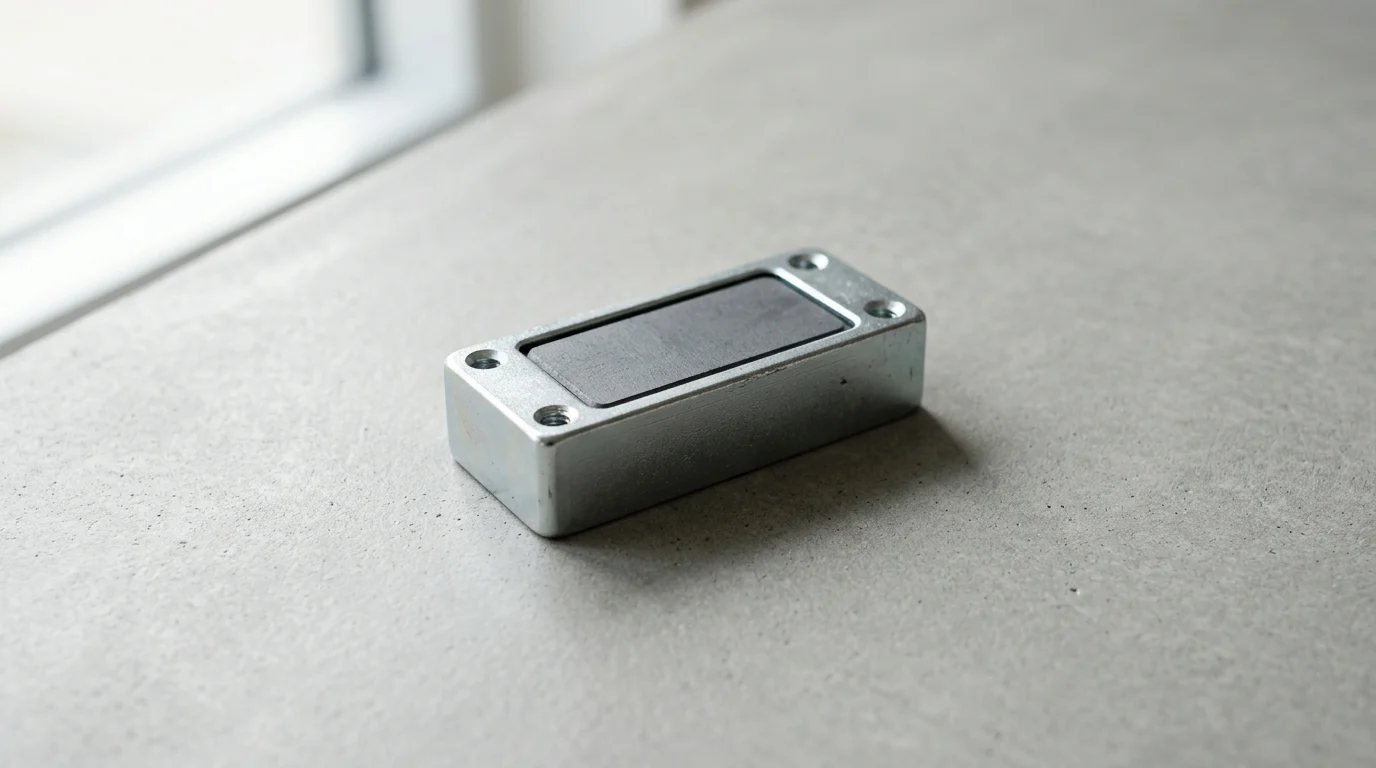
A magnetic fixture that looks strong on paper can fail quickly if the load direction, vibration level, or mounting surface is misunderstood. In equipment design, rectangular pot magnets are often chosen because their broad, flat geometry aligns well with rails, beams, frames, and machine guards while resisting rotation better than round assemblies. But the correct choice is not just about length and width. Pull force, shear load, magnet material, steel thickness, temperature, and safety factor all affect real holding performance. This guide explains how to evaluate specifications, avoid undersizing, and select a rectangular magnetic assembly that delivers reliable, repeatable performance in demanding industrial applications.
Why the Right Rectangular Pot Magnet Matters
Selecting the appropriate magnetic assembly for industrial equipment goes far beyond matching physical dimensions. In automation, material handling, and heavy engineering, the stability of a fixture or guard relies entirely on the predictable performance of its magnetic components under dynamic loads. Rectangular pot magnets have emerged as a critical hardware choice due to their unique geometry, which prevents rotation and provides a broad, flat surface area for maximum contact.
Unlike standard cylindrical variants, the rectangular profile aligns perfectly with structural beams, slotted aluminum extrusions, and linear guide rails. This geometric advantage is coupled with a highly efficient magnetic circuit, making these assemblies indispensable for engineers who must maximize holding force within strictly confined envelopes.
What a Rectangular Pot Magnet Is
A Rectangular Pot Magnet is a specialized magnetic assembly comprising a permanent magnet—typically Neodymium (NdFeB) or Ferrite—encased within a precisely machined steel channel or cup. The steel casing serves a dual purpose: it protects the brittle magnet material from mechanical impacts and acts as a flux concentrator. By redirecting the magnetic field lines from the back and sides of the magnet to the open front face, the steel channel increases the effective holding force by up to 300% compared to a bare magnet of the same volume.
These assemblies are manufactured in various standard footprints, commonly ranging from compact 10 mm x 50 mm profiles used in sensor mounting, up to robust 50 mm x 120 mm heavy-duty blocks designed for industrial workholding. The rectangular shape inherently resists rotational forces, a common point of failure for circular magnets when subjected to off-center loads. Furthermore, the steel casing typically features integrated mounting solutions, such as through-holes or threaded studs, enabling seamless integration into complex machinery without requiring secondary adhesives.
Risks of Choosing an Underspecified Magnet
Procuring an underspecified rectangular pot magnet introduces severe risks to both equipment integrity and operator safety. The most common engineering error involves confusing perpendicular holding force (pull force) with parallel holding force (shear load). In vertical mounting applications, the shear resistance of a magnet against a standard steel surface is typically only 20% to 30% of its rated perpendicular pull force. Therefore, a magnet rated for 50 kg of pull force may begin sliding down a vertical equipment panel under a mere 10 kg to 15 kg of shear load.
When dynamic forces are introduced—such as machine vibration exceeding 50 Hz, sudden pneumatic impacts, or thermal expansion—an underspecified magnet will detach. In safety guarding applications, this detachment can expose operators to moving parts, violating stringent OSHA or ISO machinery safety standards. In automated assembly lines, a slipping magnetic fixture can result in misaligned robotic welding, leading to scrap rates that far exceed the cost savings of purchasing a cheaper, lower-grade magnet. Engineers must calculate the exact vector of the applied load and apply a minimum safety factor of 3:1 to mitigate these risks.
Key Rectangular Pot Magnet Specifications
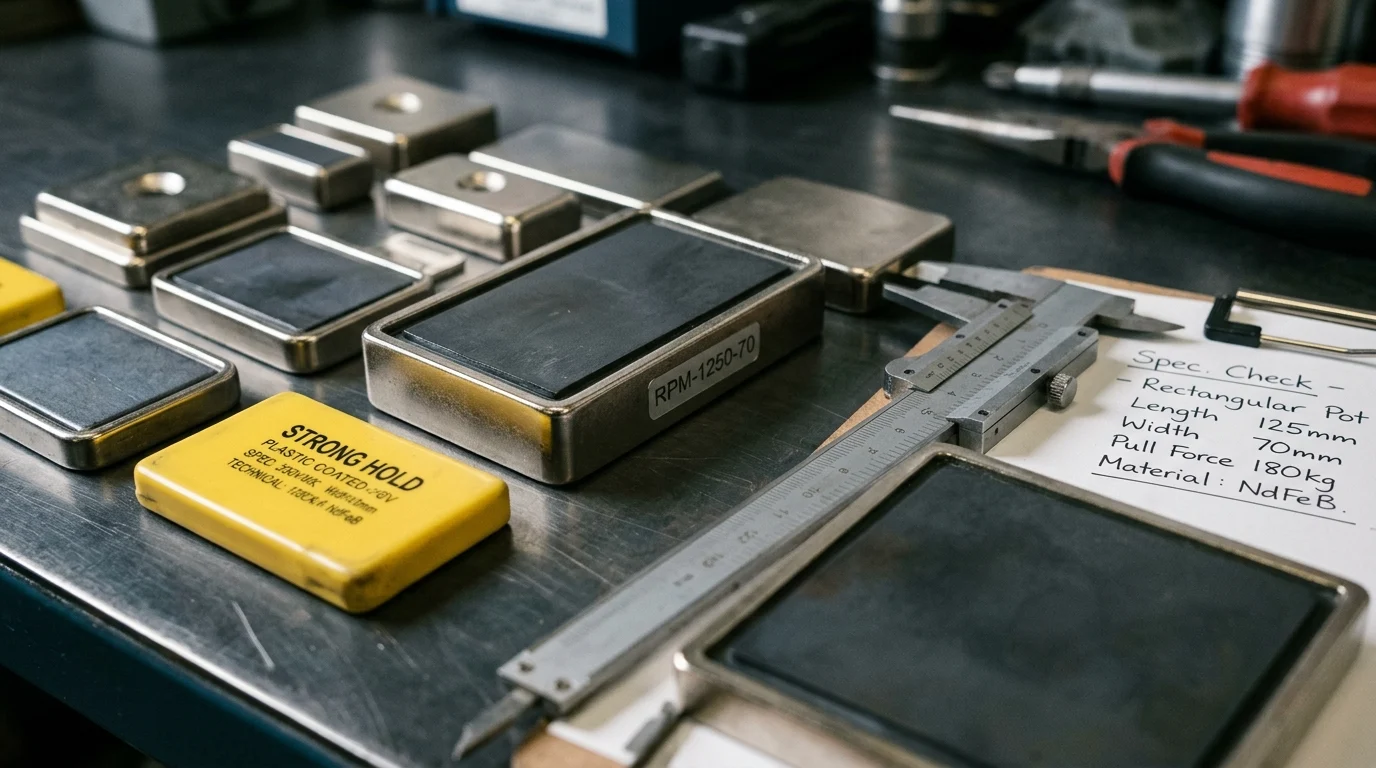
To guarantee reliable performance, buyers and engineers must evaluate a matrix of physical and magnetic specifications. The efficacy of a rectangular pot magnet is dictated by the precise interplay between its magnetic alloy, the geometry of its steel housing, and the environmental conditions of the application.
Holding Force, Shear Load, and Air Gap
The headline specification for any pot magnet is its holding force, measured in Newtons (N) or kilograms (kg), tested under ideal conditions against a thick, flat, low-carbon steel plate. However, real-world applications rarely offer ideal conditions. The introduction of an air gap—created by paint, powder coating, rust, or even a 0.5 mm layer of industrial dust—drastically degrades magnetic performance. A mere 1 mm air gap can reduce the holding force of a standard NdFeB rectangular pot magnet by 50% to 70%.
Engineers must also account for the thickness of the target material. Magnetic flux requires a sufficient volume of ferrous material to travel through; if the target sheet metal is thinner than the magnet's saturation threshold (often under 3 mm for high-power assemblies), the flux will "leak" through the back of the metal, resulting in a substantially lower holding force than the rated maximum. Buyers should request air gap and material thickness performance curves from suppliers to match the magnet's theoretical capacity with the actual operational environment.
Magnet Material and Coating Options
The internal magnet material dictates both the raw power and the thermal stability of the assembly. Sintered Neodymium (NdFeB) is the standard for high-strength applications, offering the highest maximum energy product (BHmax) ranging from 35 to 52 MGOe. However, standard NdFeB grades suffer irreversible flux loss at temperatures exceeding 80°C. For higher temperature environments, specialized high-coercivity grades (such as N42SH or N35EH) must be specified, pushing the operating limit up to 150°C or 200°C.
Because NdFeB is highly susceptible to oxidation, the coating applied to the magnet before it is glued into the steel channel is critical. The industry standard is a triple-layer Nickel-Copper-Nickel (Ni-Cu-Ni) electroplating, typically measuring 10 to 20 microns in thickness. For applications involving moisture or mild chemical exposure, Zinc plating (5-10 microns) or a durable Epoxy coating (15-30 microns) may be specified to enhance salt spray resistance. The steel channel itself is usually zinc-plated or nickel-plated to prevent environmental degradation.
Mounting Holes, Threads, and Installation Features
The method of mechanical attachment is a decisive factor in selecting a rectangular pot magnet. Manufacturers offer various standardized profiles to accommodate different fastener types. A Rectangular Countersunk Magnet features a conical hole designed to accept flat-head screws (e.g., M3, M4, M5). This design ensures the screw head sits flush with or slightly below the magnetic surface, preventing the fastener from creating an unintended air gap that would diminish holding power.
Alternatively, a Counterbored Pot Magnet features a straight-sided recessed hole, ideal for socket head cap screws or pan head machine screws. When installing these magnets, strict adherence to torque specifications is mandatory. Over-tightening a steel screw against the brittle magnetic material can cause the magnet to fracture within its casing. For example, tightening an M4 screw into a standard countersunk NdFeB magnet typically carries a maximum torque limit of 2.0 to 2.5 Nm. Using thread-locking fluid rather than excessive torque is the recommended engineering practice to secure these assemblies in high-vibration environments.
How to Compare Rectangular Pot Magnet Options
Navigating the diverse landscape of rectangular pot magnets requires a systematic comparison of material properties and geometric configurations. Buyers must align the specific mechanical and thermal demands of their equipment with the inherent capabilities of different magnetic assemblies.
Neodymium vs Ferrite Rectangular Pot Magnets
The primary decision in selecting a rectangular pot magnet is choosing between Neodymium (NdFeB) and Ferrite (Ceramic) internal magnets. This choice dictates the assembly's size-to-strength ratio, thermal ceiling, and unit cost.
| Specification Metric | Neodymium (NdFeB) Pot Magnets | Ferrite (Ceramic) Pot Magnets |
|---|---|---|
| Relative Holding Force | Very High (up to 10x Ferrite) | Low to Moderate |
| Max Operating Temperature | 80°C standard (up to 200°C special) | 250°C standard |
| Corrosion Resistance | Low (Requires robust plating) | Excellent (Rust-proof inherently) |
| Cost per Unit | High | Low |
| Ideal Application Profile | Compact spaces requiring massive force | High-heat, wet environments, large areas |
Neodymium is mandatory when equipment real estate is heavily constrained but high holding force is non-negotiable. Conversely, Ferrite rectangular pot magnets are highly favored in welding fixtures, high-temperature painting lines, or outdoor agricultural equipment where the assembly will be subjected to temperatures exceeding 200°C or constant moisture, environments that would rapidly degrade standard NdFeB.
Use Cases for Fixtures, Guards, Sensors, and Equipment
The rectangular form factor is uniquely suited to specific industrial applications where cylindrical magnets fall short. In machining fixtures, long rectangular pot magnets (e.g., 120 mm lengths) are used to hold heavy 200 kg steel plates flat against a CNC bed. Their linear shape prevents the workpiece from pivoting during milling operations.
For safety guards on stamping presses, rectangular magnets provide a continuous line of holding force along the edge of the Lexan or wire mesh guard, ensuring complete closure without gaps. In sensor mounting, miniature rectangular pot magnets are utilized to attach proximity sensors to moving steel gantries. The straight edges of the magnet allow it to be aligned perfectly parallel to the sensor housing, ensuring the strict < 0.5 mm tolerances required to maintain consistent signal transmission.
When to Choose a Custom Rectangular Pot Magnet
While off-the-shelf rectangular pot magnets cover approximately 80% of industrial needs, certain high-performance applications necessitate custom engineering. Buyers should consider custom designs when standard dimensions do not fit the existing equipment footprint, or when specific magnetic field profiles (such as multi-pole magnetization on a single face) are required to interact with specialized sensors.
Transitioning to a custom rectangular pot magnet involves specific procurement metrics. Suppliers typically require Minimum Order Quantities (MOQs) ranging from 1,000 to 5,000 units to justify the setup. Lead times for custom assemblies generally extend to 4 to 8 weeks, incorporating the creation of specific steel stamping dies or CNC machining programs. Tooling costs for custom steel channels are relatively low—often ranging between $500 and $1,500—making custom geometries highly accessible for mid-to-large volume OEM production runs.
Sourcing and Quality Requirements
Procuring rectangular pot magnets from global supply chains requires rigorous quality assurance protocols. The visual similarity between a premium magnetic assembly and a low-grade counterfeit makes it imperative for buyers to rely on empirical data, standardized testing, and verifiable compliance documentation rather than visual inspection alone.
Supplier Documentation to Request
To verify the performance claims of a supplier, procurement teams must request comprehensive technical documentation before authorizing bulk orders. The most critical document is the B-H curve (hysteresis loop) report for the specific batch of raw magnetic material used in the assembly. This report confirms the intrinsic coercivity (Hcj) and remanence (Br), ensuring the material matches the specified grade (e.g., N42 vs. N35).
Additionally, buyers should demand pull force test reports. Reputable manufacturers utilize universal testing machines to pull the magnet perpendicularly from a standard 10 mm thick low-carbon steel plate at a consistent speed—typically 10 mm/min. Requesting these baseline reports ensures that the batch meets the minimum Newton (N) rating specified on the purchase order, protecting the buyer from receiving assemblies built with undersized internal magnets.
Corrosion Resistance and Coating Consistency
Because the internal NdFeB magnet is highly reactive to oxygen and moisture, the integrity of the coating and the steel channel is paramount to the assembly's lifespan. Coating consistency is verified through Salt Spray Testing (SST) in accordance with ASTM B117 standards. A standard Ni-Cu-Ni coated magnet should withstand 24 to 48 hours of continuous salt fog exposure without showing signs of red rust or blistering.
For harsh environments, suppliers should provide validation that specialized epoxy or Teflon coatings can surpass 500+ hours in the salt spray chamber. Furthermore, coating thickness consistency is critical; variations greater than 5 microns can create uneven surfaces, micro-air gaps, and ultimately, a reduction in the theoretical holding force. Advanced suppliers utilize X-ray fluorescence (XRF) spectrometers to measure and guarantee plating thickness across production batches.
Regulatory, Safety, and Compliance Factors
Industrial components must adhere to global environmental and safety directives. Rectangular pot magnets imported into the European Union or North America must comply with RoHS 3 (Directive 2015/863) and REACH regulations. This compliance ensures that the magnets and their protective platings contain restricted heavy metals—such as Lead (Pb), Cadmium (Cd), and Mercury (Hg)—at levels strictly below the 0.1% threshold.
From a quality management perspective, sourcing from suppliers certified to ISO 9001:2015 is non-negotiable for critical applications. For integration into automotive or aerospace equipment, buyers may require the stricter IATF 16949 certification. These frameworks ensure that the manufacturer maintains strict lot traceability and statistical process control (SPC), keeping defect rates below 50 parts per million (ppm), which is essential when a single failing magnet could lead to catastrophic equipment malfunction.
How Buyers Should Make the Final Selection
The final selection of a rectangular pot magnet is a calculated balance between mechanical requirements, environmental constraints, and lifecycle economics. Procurement and engineering teams must collaborate to ensure the chosen assembly delivers reliable performance without inflating the total cost of ownership.
Step-by-Step Selection Process
A rigorous selection process begins with an accurate load analysis. Engineers must calculate the maximum combined forces (pull, shear, and peel) the magnet will encounter, then multiply the highest expected load by a safety factor of 3 to 5 to account for unexpected dynamic shocks or suboptimal surface conditions. Next, the operating environment must be defined, specifically noting peak ambient temperatures and exposure to corrosive agents, which will dictate the choice between NdFeB and Ferrite, as well as the required plating.
Once the material and force requirements are established, the physical integration is finalized by selecting the appropriate mounting style (countersunk, counterbored , or threaded stud) that aligns with the equipment's existing fastening standards. Before committing to a high-volume purchase, buyers should acquire a prototype batch of 10 to 50 units. These prototypes must be tested in-situ on the actual equipment to validate holding force through any existing paint layers and to confirm that vibration frequencies do not induce shear slippage.
Total Cost, Replacement Intervals, and Long-Term Value
Evaluating the true cost of a rectangular pot magnet extends far beyond the initial piece price. A substandard magnet that fails prematurely drives up maintenance costs and forces expensive equipment downtime.
| Cost Driver | Typical % of Unit Cost | Impact on Long-Term Value & Lifespan |
|---|---|---|
| Raw Magnetic Material (NdFeB/Ferrite) | 50% - 70% | Determines baseline strength and thermal degradation rate. |
| Steel Channel Machining | 10% - 20% | Affects flux concentration efficiency and mounting precision. |
| Coating & Plating Quality | 10% - 20% | Dictates corrosion resistance; failure here destroys the magnet. |
| Quality Control & Testing | 5% - 10% | Prevents premature field failures and ensures batch consistency. |
Consider the Return on Investment (ROI) of specifying a premium magnet. Purchasing a $2 low-grade assembly might save money upfront, but if its inferior plating allows moisture ingress, the internal magnet will swell, crack, and fail within 6 months. The labor cost to dispatch a maintenance technician to replace the fixture often exceeds $50 to $100 per hour, dwarfing the initial component savings. Conversely, investing in a $5 heavily plated, highly specified rectangular pot magnet ensures a functional lifespan of 5 to 10 years, dramatically reducing replacement intervals and delivering vastly superior long-term value to the facility.
Further reading:
Key Takeaways
- Match the rectangular pot magnet to the actual load direction because shear capacity may be only 20% to 30% of the rated pull force.
- Apply a minimum 3:1 safety factor when the magnet is used on industrial equipment exposed to vibration, impacts, or operator safety risks.
- Choose a rectangular profile for rails, beams, slotted aluminum frames, and fixtures where anti-rotation stability is more important than a compact round footprint.
- Use Neodymium when high holding force is required in a limited space, and consider Ferrite when cost, corrosion resistance, or temperature behavior is the priority.
- Verify the mounting method, such as through-holes or threaded studs, before purchase to ensure the magnet integrates cleanly into the equipment design.
- Account for real surface conditions because gaps, coatings, thin steel, roughness, and misalignment can significantly reduce holding performance.
Frequently Asked Questions
What is a rectangular pot magnet used for?
A rectangular pot magnet is used for equipment fixtures, guards, sensors, workholding, and mounting on beams, rails, or aluminum profiles where a flat, anti-rotation magnetic hold is needed.
Why choose a rectangular pot magnet instead of a round pot magnet?
The rectangular shape better matches linear equipment surfaces and resists rotation under off-center loads, making it useful for rails, frames, and fixtures exposed to vibration or directional forces.
How much safety factor should I use when selecting one?
For industrial equipment, use at least a 3:1 safety factor after calculating the real load direction, surface condition, vibration, and whether the force is pull or shear.
Is pull force the same as shear holding force?
No. Shear holding force on a vertical surface is often only about 20% to 30% of the rated perpendicular pull force, so a 50 kg pull rating may hold only 10 kg to 15 kg in shear.
Which magnet material is better, Neodymium or Ferrite?
Neodymium offers stronger holding force in a compact size, while Ferrite is more economical and has good corrosion and temperature resistance. The right choice depends on load, space, environment, and budget.