 EN
EN AR
AR HR
HR CS
CS DA
DA NL
NL FI
FI FR
FR DE
DE EL
EL IT
IT JA
JA KO
KO NO
NO PL
PL PT
PT RU
RU ES
ES SV
SV IW
IW VI
VI TH
TH TR
TR FA
FA MS
MS

Metal debris below the waterline is more than an eyesore—it can damage propellers, obstruct drainage, threaten bridge work, and introduce long-term environmental risk. High-strength fishing magnets give municipalities, contractors, and recovery teams a practical way to target ferrous waste without the disruption and cost of full-scale dredging. This article explains where magnetic recovery works best, which metals respond to neodymium pull force, and what site factors—such as current speed, depth, and mud thickness—can make or break efficiency. It also highlights realistic commercial use cases, safety considerations, and specification points to help operators choose the right magnetic salvage tool for controlled, productive cleanup.
How Fishing Magnets Fit Commercial Metal Recovery
Commercial metal recovery demands efficient, scalable solutions to manage submerged debris that threatens navigational hazards, infrastructure integrity, and environmental health. Integrating a specialized Magnetic Salvage Tool into debris management protocols allows operators to extract ferrous materials without the extensive mobilization required by heavy dredging machinery.
By leveraging high-strength neodymium magnetic fields, recovery teams can pinpoint and extract metallic waste from aquatic environments rapidly. This approach bridges the gap between surface-level skimming and invasive underwater excavation, providing a targeted extraction method that minimizes ecological disruption while maximizing material recovery rates.
Industrial and municipal use cases
Municipal waterways, commercial ports, and industrial runoff channels frequently accumulate substantial metallic debris. Before deployment, operators must secure appropriate local permits and clarify salvage rights, as municipal and commercial waterways are strictly regulated. In commercial harbors, dropped tools, discarded scaffolding, and heavy maritime hardware pose continuous risks to vessel hulls and propellers. Municipalities utilize magnetic recovery to clear urban canals and recreational waterways of bicycles, shopping carts, and automotive parts.
Industrial applications also extend to post-construction cleanup near bridge abutments and retaining walls, where contractors must remove dropped rebar, fasteners, and structural steel fragments. In these environments, under optimal conditions, deploying magnetic tools can recover up to 500 pounds of localized ferrous waste per hour, significantly reducing the hazard footprint before final project sign-off.
Recoverable metal debris types
The efficacy of magnetic retrieval is strictly limited to ferromagnetic materials, primarily iron, steel, and specific nickel or cobalt alloys. Fortunately, urban and industrial waterway debris profiles typically consist of a predominantly ferrous composition, historically estimated at 65% to 80% ferrous content by weight depending on regional infrastructure. Common recoverable items include structural ironwork, automotive engine blocks, steel cables, and industrial fasteners.
It is critical to note that non-ferrous metals such as aluminum, brass, copper, and austenitic stainless steels (like 304 or 316 grades) will not react to the magnetic field. Operators must conduct preliminary material assessments to ensure the target debris falls within the ferromagnetic spectrum, thereby justifying the deployment of magnetic recovery systems .
Site conditions and access requirements
Successful magnetic recovery relies heavily on specific site conditions, particularly water flow velocity, depth, and substrate composition. Ideal operational environments feature water currents below 3 knots; exceeding this velocity creates excessive drag on the retrieval lines and can dislodge captured debris from the magnet's surface.
Depth capabilities generally extend up to 150 feet, provided operators utilize adequately rated winches and low-stretch synthetic lines. Substrate conditions play a vital role; while magnets excel in rocky or sandy riverbeds, deep silt or viscous mud exceeding 12 inches in depth can bury debris, creating a physical barrier that degrades the effective magnetic pull force and prevents solid contact.
Key Fishing Magnet Specifications
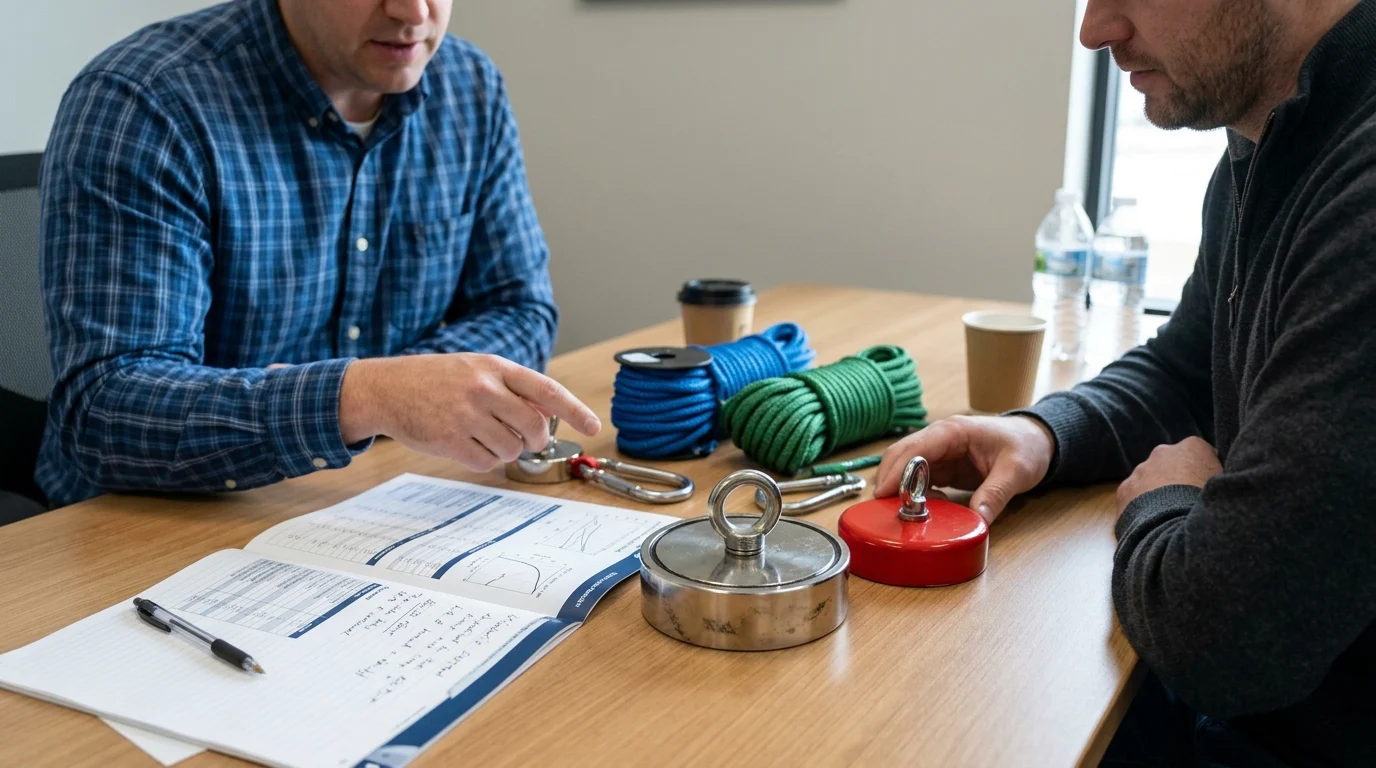
Understanding the technical anatomy of a Fishing magnet is essential for engineering a successful recovery operation. The core specifications dictate the tool's maximum lifting capacity, durability in corrosive environments, and suitability for specific underwater topographies.
Industrial-grade units are precisely engineered assemblies, utilizing advanced rare-earth materials housed within protective casings. Selecting the correct specifications ensures the equipment can withstand the dynamic shock loads and abrasive conditions inherent to commercial salvage.
Pull force, magnet grade, and cup design
The driving engine of any commercial retrieval magnet is its neodymium core, typically synthesized at an N52 magnetization grade—the highest commercially available strength. This grade yields exceptional magnetic flux density. Pull force ratings, which range from 1,200 lbs to over 3,600 lbs in industrial models, are measured under ideal laboratory conditions involving a flat, 10mm thick steel plate.
To direct this immense power, the neodymium core is encased in a machined steel cup. This cup serves a dual purpose: it shields the brittle rare-earth magnet from direct impact shattering and redirects the magnetic field lines downward, effectively concentrating and amplifying the pull force at the contact face.
Single-sided vs double-sided magnets
Form factor dictates the operational deployment strategy. A Single-sided Fishing Magnet concentrates its entire magnetic flux on one flat surface. This design is optimal for vertical "dip and lift" operations, such as clearing debris directly beneath a pier, bridge deck, or stationary crane, where the magnet lands flat on the target.
Conversely, double-sided magnets feature exposed magnetic faces on both the top and bottom, with the primary attachment point located on the edge. This configuration is engineered for dragging operations across riverbeds or harbor floors. As the magnet tumbles along the substrate, it maintains a constant active magnetic field facing the debris, increasing the probability of contact during horizontal sweeps. Additionally, 360-degree magnets provide an omnidirectional magnetic field, making them highly effective for deep-water deployments over uneven terrain or irregular substrates where a flat connection is impossible.
| Form Factor | Primary Application | Magnetic Field Distribution | Best Deployment Method |
|---|---|---|---|
| Single-Sided | Vertical lifting | Concentrated on one face | Static drops from bridges/docks |
| Double-Sided | Horizontal dragging | Split across two faces | Towed behind vessels or walked along banks |
| 360-Degree | Uneven terrain | Omnidirectional | Deep water with irregular substrates |
Ropes, eye bolts, shackles, and coatings
The auxiliary hardware is as critical as the magnet itself. Recovery lines must exhibit minimal stretch and high tensile strength; Ultra-High-Molecular-Weight Polyethylene (UHMWPE) or marine-grade static ropes with diameters between 8mm and 12mm and breaking strengths exceeding 4,000 lbs are standard. Standard nylon ropes are discouraged due to their elasticity, which creates a dangerous slingshot effect if the magnet suddenly dislodges.
Attachment points rely on heavy-duty 304 or 316 stainless steel eye bolts and rated bow shackles. To prevent the eye bolt from unscrewing under rotational underwater forces, operators must apply an anaerobic threadlocker (such as Loctite 262) and allow a 24-hour cure time. Furthermore, the magnet assembly requires a robust Ni-Cu-Ni (Nickel-Copper-Nickel) triple-layer coating, typically 15 to 20 microns thick, to prevent rapid oxidation and galvanic corrosion in saltwater environments.
Fishing Magnets vs Other Recovery Methods
Evaluating recovery options requires a systematic comparison of available technologies against the specific demands of the project site. While traditional methods have proven track records, they often introduce significant logistical burdens and elevated operational costs.
Magnetic retrieval serves as a highly efficient alternative or complementary technique to mechanical dredging and commercial diving, particularly when dealing with scattered, localized ferrous contamination.
Comparison criteria for recovery options
Project managers evaluate metal recovery methods based on mobilization time, environmental footprint, operational hazard levels, and cost per ton of recovered material. Mechanical dredging involves heavy excavators or suction pumps, requiring extensive permitting and creating massive sediment disturbance. Commercial diving offers high precision but introduces severe life-safety risks.
Magnetic retrieval operates in the middle of this spectrum. It requires minimal mobilization—often deploying from small watercraft or shorelines within minutes—and causes negligible sediment displacement, making it highly favorable for environmentally sensitive zones or areas with strict turbidity regulations.
Depth, substrate, visibility, and current factors
Environmental variables drastically alter the efficacy of each method. In zero-visibility turbid water conditions, commercial diving becomes exponentially more dangerous and slower, relying entirely on tactile searches. Dredging is indifferent to visibility but struggles to differentiate between mud and target debris, resulting in high volumes of contaminated spoil that require expensive processing.
Magnets excel in high-turbidity, zero-visibility environments because the magnetic field actively attracts the target, compensating for the lack of visual confirmation. While high-velocity currents or deep, unconsolidated silt can limit lightweight magnetic rigs—as previously noted—they remain highly effective on hard-packed clay, sand, or gravel where debris remains within the magnetic field's reach.
Cost and efficiency advantages
The financial advantages of magnetic retrieval are substantial when applied to appropriate scenarios. Mobilizing a commercial dive team typically incurs costs ranging from $1,500 to $3,000 per day, factoring in personnel, breathing gases, and safety standby requirements. Mechanical dredging operations easily exceed $10,000 per day when including barge transport and spoil disposal fees.
In contrast, a commercial-grade magnetic recovery team can operate with an equipment rental and maintenance overhead of $200 to $500 per day. While total operational costs must also factor in labor, vessel charters, and insurance, the overall expense remains a fraction of traditional dredging. The cost per targeted ferrous item is exponentially lower, making magnetic retrieval the preferred initial sweep tactic. However, project managers must account for the fact that magnetic retrieval is entirely ineffective for non-ferrous materials or deeply buried debris.
| Recovery Method | Setup Time | Estimated Daily Cost | Environmental Impact | Best For |
|---|---|---|---|---|
| Magnetic Retrieval | < 1 Hour | $200 - $500 | Very Low | Scattered ferrous debris, zero visibility |
| Commercial Diving | 2 - 4 Hours | $1,500 - $3,000 | Low | Complex rigging, non-ferrous items |
| Mechanical Dredging | 2 - 5 Days | $10,000+ | High | Massive volume removal, deep silt clearance |
Best Practices for Efficient Retrieval
Deploying magnetic systems effectively requires disciplined operational protocols. Randomly casting magnets into a waterway yields inconsistent results and increases the risk of equipment loss or infrastructure damage.
Establishing rigorous best practices ensures that the recovery zone is systematically cleared, maximizing the tonnage of extracted metal while safeguarding personnel and the surrounding marine environment.
Site surveys and recovery zone planning
Prior to deployment, teams must conduct comprehensive site surveys to map the recovery zone. Integrating high-frequency sonar, such as CHIRP systems operating at 455 kHz or 800 kHz, allows operators to identify large structural debris, submerged utility lines, and sudden topographical drop-offs. This prevents the magnet from becoming permanently anchored to immovable infrastructure like sheet piling or underwater pipelines.
Based on the sonar data, operators establish a grid pattern for the recovery zone. This planning phase dictates the length of the throw lines required and identifies safe staging areas for the extracted bio-fouled debris, ensuring that runoff does not re-enter the waterway.
Retrieval patterns and contact techniques
Execution relies on systematic retrieval patterns. For horizontal dragging operations, teams should utilize overlapping drag lines, maintaining a 20% to 30% overlap on each pass to ensure total coverage of the substrate. The angle of the retrieval line relative to the water bottom should ideally remain between 30 and 45 degrees; steeper angles tend to lift the magnet off the bottom, breaking contact with potential targets.
Winch or manual retrieval speeds must be strictly controlled. Pulling the magnet at speeds exceeding 2 feet per second increases hydrodynamic drag, which can easily strip heavier items off the magnetic face before they reach the surface. A slow, steady retrieval allows the magnetic field to maintain its grip through water resistance and snag hazards.
Safety, environmental, and transport controls
Safety controls are paramount due to the extreme forces involved. Industrial neodymium magnets generate pinch forces that can easily exceed hundreds of pounds, presenting catastrophic crush hazards capable of amputating fingers or shattering bone if appendages are caught between the magnet and a steel object. Personnel must wear heavy-duty, cut-resistant gloves and maintain strict hand-clearance protocols during detachment.
Furthermore, operators must enforce a minimum 3- to 6-foot (1 to 2 meters) safety exclusion zone around the magnets for any personnel with pacemakers or sensitive medical implants. Additionally, operators must be prepared for the inadvertent recovery of hazardous materials or unexploded ordnance (UXO), requiring immediate cessation of activities and notification of local authorities. Transporting these tools requires specialized non-magnetic isolation cases, typically lined with at least 2 inches of dense foam padding, to prevent the magnets from inadvertently attaching to vehicle chassis or interfering with navigation electronics during transit.
How to Select the Right Fishing Magnet
Procurement requires a calculated approach to match equipment specifications with anticipated project demands. Over-specifying a magnet can lead to unmanageable handling risks, while under-specifying results in lost debris and operational inefficiency.
Selecting the optimal equipment involves evaluating theoretical capacity against real-world underwater physics, auditing supplier credentials, and mitigating the financial risks of equipment loss.
Capacity and form factor decision matrix
Developing a capacity decision matrix is the first step in procurement. The foundational rule of magnetic salvage is that the rated pull force is calculated under perfect, dry, flush-contact conditions. In underwater environments characterized by rust, algae, curved surfaces, and leverage forces, the actual working capacity drops to approximately 10% to 20% of the rated limit.
Therefore, to reliably retrieve a 100-pound submerged engine block or steel beam, operators must select a magnet with a minimum rated pull force of 1,000 to 1,500 pounds. Factoring in this safety margin ensures the magnetic grip can withstand the hydrodynamic drag experienced as the object is pulled upward through the water column.
Supplier quality and documentation checks
Commercial buyers must rigorously verify supplier quality and technical documentation. Reputable manufacturers should operate under ISO 9001 quality management systems, ensuring consistent rare-earth alloy mixtures and reliable assembly tolerances. Buyers should request Material Test Reports (MTRs) to verify the exact grade of the neodymium core (e.g., confirming genuine N52 specs).
Additionally, suppliers should provide Gauss meter testing results that validate the surface flux density. Inferior products often utilize lower-grade magnets (N35 or N42) hidden within oversized steel casings to simulate the weight and appearance of industrial tools, resulting in rapid demagnetization and poor operational performance.
Balancing performance, cost, and project risk
Balancing performance with project risk requires treating the magnet as an operational consumable rather than a permanent capital asset. In complex underwater environments with heavy rock formations or immovable steel structures, the risk of snagging and permanently losing a magnet is statistically significant.
To mitigate this, operators must balance the cost of ultra-high-capacity magnets against the likelihood of loss. Implementing breakaway systems—such as secondary retrieval lines attached to the rear of the magnet housing—can help reverse the tool out of snags. Ultimately, selecting equipment that offers a high strength-to-cost ratio allows commercial teams to maintain operational tempo and quickly replace lost units without derailing the project budget.
Further reading:
Key Takeaways
- Use fishing magnets for ferrous debris such as iron, steel, rebar, tools, cables, and fasteners, but not for aluminum, brass, copper, or most stainless steel.
- Check permits, access rights, and salvage rules before deploying magnetic recovery equipment in municipal waterways, ports, or industrial channels.
- Plan magnetic recovery where currents stay below 3 knots, because stronger flow increases drag and can pull debris off the magnet.
- Assess bottom conditions before work, since silt or mud deeper than 12 inches can prevent solid contact and reduce effective pull force.
- Match magnet strength, line rating, and winch capacity to the site depth and target debris weight, especially for operations approaching 150 feet.
Frequently Asked Questions
What types of debris can a fishing magnet recover?
Fishing magnets recover ferromagnetic materials such as iron, steel, and some nickel or cobalt alloys. Common finds include rebar, tools, steel cables, fasteners, bicycles, and automotive parts.
Will a fishing magnet pick up aluminum, brass, copper, or stainless steel?
No. Aluminum, brass, copper, and most 304 or 316 stainless steels are non-ferrous and will not respond effectively to a fishing magnet.
What site conditions are best for magnetic recovery?
Best results come in currents below 3 knots, depths within equipment limits, and rocky or sandy beds. Deep mud or silt over 12 inches can block contact and reduce pull strength.
How much metal debris can commercial teams recover per hour?
Under optimal localized conditions, magnetic recovery teams may recover up to 500 pounds of ferrous waste per hour, especially in ports, canals, and construction cleanup zones.
Do operators need permits for commercial magnet fishing?
Often, yes. Municipal waterways, ports, and industrial sites are regulated, so operators should confirm permits, access permissions, and salvage rights before beginning recovery work.