 EN
EN AR
AR HR
HR CS
CS DA
DA NL
NL FI
FI FR
FR DE
DE EL
EL IT
IT JA
JA KO
KO NO
NO PL
PL PT
PT RU
RU ES
ES SV
SV IW
IW VI
VI TH
TH TR
TR FA
FA MS
MS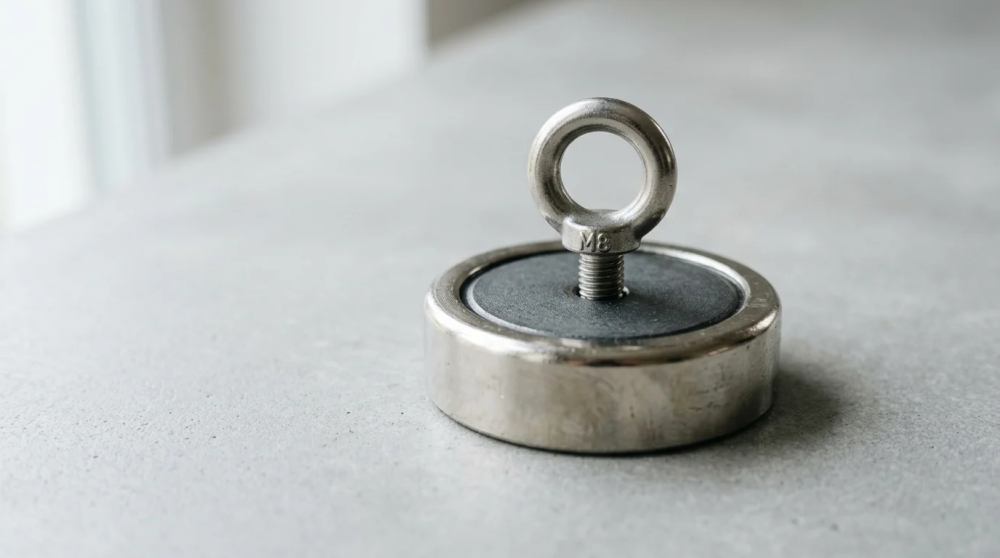
Introduction
Choosing a pot magnet for industrial use is less about the housing alone and more about how the core material behaves under real operating demands. Magnetic strength, temperature tolerance, corrosion resistance, and long-term stability can vary sharply between neodymium, ferrite, samarium cobalt, and alnico designs, affecting both performance and maintenance cost. This comparison explains how the main pot magnet materials differ, where each one fits best, and which tradeoffs matter most when specifying parts for lifting, sensing, fixturing, or automation equipment.
Why Pot Magnet Material Selection Matters
Pot magnets, characterized by a permanent magnet encased within a steel shell or cup, are fundamental components in modern industrial engineering. The steel casing serves a dual purpose: it protects the brittle magnetic core from mechanical impacts and strategically redirects the magnetic field to a single active face. This redirection can amplify the holding force of the assembly by up to three or four times compared to a standard, un-encased magnet.
Because the operational efficacy of a pot magnet relies heavily on the synergistic relationship between the magnetic core and the steel cup, selecting the appropriate core material is a critical engineering decision. The chosen material directly dictates the magnetic assembly's physical strength, environmental resilience, and overall lifecycle cost.
Holding Force, Temperature, and Service Life
The relationship between holding force, thermal stability, and service life forms the foundation of pot magnet material selection. Different magnetic alloys exhibit drastically different responses to thermal stress. For instance, standard commercial grades of Neodymium offer exceptional pulling power but typically suffer irreversible flux losses if exposed to temperatures exceeding 80°C without specialized high-temperature alloying.
When a magnet operates beyond its Maximum Operating Temperature but below its Curie temperature, it experiences a reversible loss in magnetic output. However, repeatedly pushing the material past its specific thermal threshold can lead to an irreversible flux loss of 5% to 20%, drastically reducing the safe holding capacity and shortening the assembly's service life. Engineers must calculate thermal safety margins carefully to ensure the holding force remains reliable over years of continuous industrial use.
Industrial Applications and Material Needs
Industrial applications impose diverse operational demands that no single magnetic material can universally satisfy. In heavy manufacturing and material handling, pot magnets are often tasked with securing or lifting heavy steel plates, sometimes requiring individual assemblies rated for vertical pull forces exceeding 500 kg. In these scenarios, maximum magnetic energy density is the primary driver.
Conversely, applications in the aerospace or oil and gas sectors prioritize absolute stability under extreme environmental stress over raw holding power. Sensors and holding brackets deployed in downhole drilling operations or high-heat fabrication facilities require materials that resist demagnetization in high-temperature, corrosive environments. Understanding whether an application prioritizes raw strength, thermal stability, or chemical resistance is the first step in successful material specification.
Common Pot Magnet Materials Compared
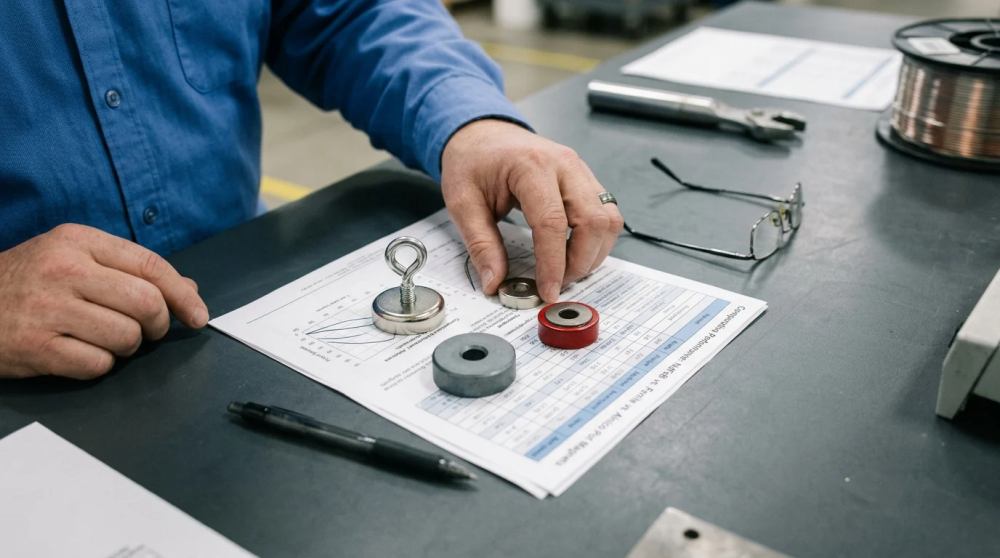
The core of a commercial pot magnet is typically manufactured from one of four primary permanent magnet families: Neodymium Iron Boron (NdFeB), Ferrite (Ceramic), Samarium Cobalt (SmCo), or Alnico. Each material possesses a distinct combination of magnetic remanence, coercivity, and thermal resistance, making them suitable for entirely different industrial niches.
Neodymium vs Ferrite vs Samarium Cobalt vs Alnico
Neodymium (NdFeB) is the most powerful commercially available magnetic material, with energy products ranging from N35 to N52. It provides the highest holding force per cubic centimeter, allowing for highly compact pot magnet designs. However, it is vulnerable to oxidation and has a relatively low standard thermal threshold. Ferrite magnets, composed of strontium or barium carbonate and iron oxide, offer a highly cost-effective alternative. While they produce significantly less holding force, they are inherently immune to corrosion and maintain stability up to 250°C.
Samarium Cobalt (SmCo) bridges the gap between raw power and extreme environmental resistance. It delivers magnetic strength comparable to mid-grade Neodymium but can operate safely in environments reaching 350°C without the need for protective plating. Alnico, an alloy of aluminum, nickel, and cobalt, offers the highest thermal stability of all, functioning effectively in environments up to 550°C. However, Alnico has a lower coercive force, making it more susceptible to demagnetization from external magnetic fields.
Strength, Corrosion Resistance, and Cost Comparison
Evaluating these materials requires a comparative analysis of their physical and economic attributes. The following table illustrates the baseline performance and cost metrics for the four primary pot magnet core materials.
| Material | Max Operating Temp | Relative Cost | Pull Force | Corrosion Resistance |
|---|---|---|---|---|
| Neodymium (NdFeB) | 80°C - 200°C | Moderate - High | Very High | Low (Requires Coating) |
| Ferrite (Ceramic) | Up to 250°C | Low | Low - Moderate | Excellent |
| Samarium Cobalt | Up to 350°C | Very High | High | Excellent |
| Alnico | Up to 550°C | High | Moderate | Good |
Cost is heavily influenced by raw material availability and machining difficulty. SmCo commands a premium due to the scarcity of cobalt and samarium, whereas Ferrite remains highly economical for bulk industrial applications where spatial constraints are minimal.
How to Evaluate Performance and Durability
Specifying a pot magnet based solely on the core material's data sheet is insufficient for industrial applications. The actual performance of the assembly depends heavily on how the magnet interacts with the steel cup, the protective surface treatments applied, and the specific conditions under which the magnet interfaces with the target object.
Key Specifications and Test Conditions
Manufacturers determine the rated pull force of a pot magnet under highly controlled laboratory conditions. The industry standard test involves pulling the magnet perpendicularly away from a flat, machined, low-carbon steel plate with a minimum thickness of 10 mm. The testing apparatus typically applies force at a constant rate of 80 mm/min. Any deviation from these ideal conditions in the field will result in a lower actual holding force.
The most critical variable affecting performance is the air gap between the magnet's active face and the target surface. An air gap introduced by paint, rust, uneven surfaces, or non-magnetic coatings drastically reduces magnetic flux density. Introducing an air gap of just 1.0 mm can reduce the effective holding force of a Neodymium pot magnet by more than 50%. Furthermore, the thickness of the target steel must be sufficient to absorb all the magnetic flux; if the target is thinner than the magnet's reach, magnetic saturation occurs, and the excess flux is wasted, lowering the pull strength.
Coatings, Steel Cup Design, and Mounting Method
Because NdFeB is highly susceptible to corrosion, it requires robust surface protection. The industry standard is a triple-layer Nickel-Copper-Nickel (Ni-Cu-Ni) electroplating, typically measuring 15 to 20 microns in total thickness. For high-moisture environments, engineers may specify epoxy coatings or enclose the magnet in a 304 or 316 stainless steel cup, though stainless steel slightly diminishes the magnetic circuit's efficiency compared to Q235 carbon steel.
The mounting method also dictates the steel cup's design. Pot magnets are available with countersunk holes for flush screw mounting, threaded through-holes, internal threaded bosses, or external threaded studs. The structural integrity of the mounting point must exceed the pull force of the magnet; otherwise, the mechanical fastener will fail before the magnetic bond breaks.
Sourcing, Quality, and Compliance Checks
Procuring industrial-grade pot magnets requires stringent supply chain oversight. Magnetic assemblies are subject to strict dimensional tolerances, quality control standards, and international transport regulations due to the inherent risks posed by strong magnetic fields.
How to Assess Suppliers and Production Quality
When auditing a magnetic assembly supplier, procurement teams must verify adherence to international quality management frameworks, such as those established by the ISO. A reputable manufacturer operating under ISO 9001 standards will provide detailed inspection reports including magnetic flux density maps and pull-test certifications.
Standard Acceptable Quality Limits (AQL) for dimensional tolerances are generally set at ± 0.1 mm for the outer diameter of the steel cup and ± 0.05 mm for the internal magnetic core. Consistent concentricity between the magnet and the cup is crucial; uneven gaps can cause irregular magnetic field distribution. High-tier suppliers typically maintain a defect rate below 1.5% for bulk orders of standard pot magnet assemblies.
Packaging, Transport, and Regulatory Requirements
Transporting permanent magnets, particularly highly magnetized Neodymium assemblies, involves strict regulatory compliance. When shipped by air, pot magnets must comply with the International Air Transport Association (IATA) Dangerous Goods Regulations, specifically Packing Instruction 953.
To pass air freight standards, the packaged magnets must not emit a magnetic field exceeding 0.00525 gauss at a distance of 4.6 meters from any point on the surface of the package. Suppliers achieve this by arranging the pot magnets in alternating polarities to cancel out the external fields and by lining the shipping cartons with specialized iron shielding sheets. Failure to meet these packaging requirements results in immediate rejection by air carriers and potential fines.
How to Choose the Right Pot Magnet Material
Selecting the optimal pot magnet material requires a systematic approach that balances physical constraints, environmental hazards, and economic viability. By applying a structured evaluation process, engineering teams can specify assemblies that deliver reliable performance without unnecessary cost overruns.
Step by Step Material Selection Process
The material selection process can be distilled into a clear, step-by-step matrix. First, identify the peak operating temperature; if it exceeds 200°C, Neodymium is immediately disqualified. Second, calculate the required holding force and apply an appropriate safety factor. For general holding, a 2:1 safety factor is standard, but for overhead lifting applications, a minimum safety factor of 3:1 is mandated.
| Application Environment | Primary Requirement | Recommended Material | Common Steel Cup |
|---|---|---|---|
| Standard Indoor | Maximum Holding Force | Neodymium | Zinc-Plated Carbon Steel |
| High Moisture / Marine | Rust Prevention | Ferrite or SmCo | 304/316 Stainless Steel |
| High Temperature Industrial | Stability > 250°C | Samarium Cobalt | Stainless Steel |
| Welding / Fabrication | Extreme Heat > 400°C | Alnico | Carbon Steel |
Third, assess the chemical and moisture exposure to determine if specialized coatings or inherently corrosion-resistant materials like Ferrite are necessary. Finally, evaluate the dimensional constraints: if a high holding force is needed in a very confined space, higher-grade Neodymium (e.g., N45 or N52) becomes the only viable option despite its higher cost.
Common Selection Mistakes to Avoid
A frequent engineering error in pot magnet selection is failing to account for shear force. The advertised pull force represents the vertical resistance to detachment. However, if the magnet is mounted vertically on a wall and subjected to a downward sliding load, the shear capacity is typically only 15% to 25% of the vertical pull force due to the low coefficient of friction between the steel cup and the target surface. Engineers must specify rubber-coated pot magnets or design mechanical ledges to counteract shear forces.
Another common mistake is over-specifying the magnetic grade in high-temperature environments. Specifying an N52 Neodymium magnet for machinery operating at 120°C will result in rapid thermal degradation. In such cases, stepping down to an N35SH (Super High temperature) grade or transitioning to Samarium Cobalt ensures long-term operational stability, preventing premature assembly failure.
Key Takeaways
- The most important conclusions and rationale for Pot Magnet
- Specs, compliance, and risk checks worth validating before you commit
- Practical next steps and caveats readers can apply immediately
Frequently Asked Questions
Which pot magnet material gives the strongest holding force?
Neodymium pot magnets provide the highest pull force in the smallest size. Use them for compact, high-strength industrial fixtures, but check temperature limits and corrosion protection first.
When should I choose ferrite pot magnets instead of neodymium?
Choose ferrite when low cost, corrosion resistance, and higher temperature tolerance matter more than maximum pull force. They suit general industrial environments up to about 250°C.
Are pot magnets suitable for high-temperature industrial applications?
Yes, if the core material matches the heat. SmCo works well up to about 350°C, ferrite up to 250°C, and Alnico can handle even higher temperatures in specialized uses.
Do neodymium pot magnets need surface protection?
Usually yes. NdFeB is prone to oxidation, so coatings like nickel or epoxy are commonly used. For harsh or wet environments, ask suppliers like RCMAGNET about suitable plating options.
How do I choose the right pot magnet for my application?
Match the material to pull force, operating temperature, corrosion exposure, and budget. For OEM selection, RCMAGNET can help compare NdFeB, ferrite, SmCo, and Alnico options by working conditions.