 EN
EN AR
AR HR
HR CS
CS DA
DA NL
NL FI
FI FR
FR DE
DE EL
EL IT
IT JA
JA KO
KO NO
NO PL
PL PT
PT RU
RU ES
ES SV
SV IW
IW VI
VI TH
TH TR
TR FA
FA MS
MS
Introduction
Choosing between a round and rectangular pot magnet affects more than fit: it changes how magnetic force is distributed, how easily the part mounts into an assembly, and how much machining the design requires. This comparison explains where each shape performs best, from drilled holes and rotationally indifferent fixtures to linear channels and corner-constrained layouts. You’ll see how geometry influences contact area, load stability, installation tolerances, and cost, so you can match magnet shape to the mechanical demands of the application rather than relying on nominal pull-force figures alone.
Why Round vs Rectangular Pot Magnet Choice Matters
The fundamental architecture of a pot magnet features a magnetic core encased within a steel shell. This steel cup not only protects the brittle magnet material from mechanical impacts but also redirects the magnetic field to the open face, significantly amplifying the clamping force. While the internal mechanics remain consistent, the external geometry of the shell dictates how the magnet integrates into industrial assemblies.
Engineers and procurement specialists must carefully evaluate the geometric profile of these magnetic assemblies. The choice between a cylindrical and a linear footprint impacts mechanical integration, load distribution, and overall manufacturing costs. Selecting the incorrect shape can lead to suboptimal holding forces, excessive machining expenses, or premature mechanical failure in dynamic applications.
How application requirements affect shape selection
The spatial constraints of the host assembly dictate the primary geometric requirements. Round pot magnets are universally favored for their compatibility with standard manufacturing processes; they seamlessly drop into drilled or counterbored holes. This radial symmetry allows for rapid integration without strict rotational alignment. Conversely, rectangular pot magnets are engineered for linear channels and milled grooves. Their straight edges provide a flush fit against 90-degree corners, maximizing the active magnetic area in confined, rectangular spaces where a round magnet would leave unutilized corner gaps.
Furthermore, the required load profile influences shape selection. Applications subjected to torsional forces benefit greatly from rectangular profiles. A rectangular magnet physically locks into a corresponding milled slot, providing immediate mechanical resistance to twisting motions. A round magnet in a circular hole relies entirely on friction or secondary adhesives to prevent rotation, which can fail under sustained vibrational loads.
Which commercial factors influence the decision
Commercial viability often hinges on production scale and tooling investments. Round pot magnets benefit from economies of scale. The steel cups are typically manufactured using high-speed lathe turning or deep-draw stamping, resulting in low tooling costs and standard Minimum Order Quantities (MOQs) often ranging between 500 and 1,000 units. This makes them highly cost-effective for general-purpose applications.
Rectangular pot magnets generally require more complex manufacturing processes. The steel channels are usually produced via CNC milling or precision stamping with progressive dies, which carries higher initial tooling costs. Consequently, rectangular variants may command MOQs of 2,000 units or more and can exhibit a unit cost premium of 15% to 30% over their round counterparts in smaller production runs. Buyers must weigh this initial cost premium against the long-term mechanical advantages the rectangular shape provides to the final product.
Round vs Rectangular Pot Magnets: Key Differences
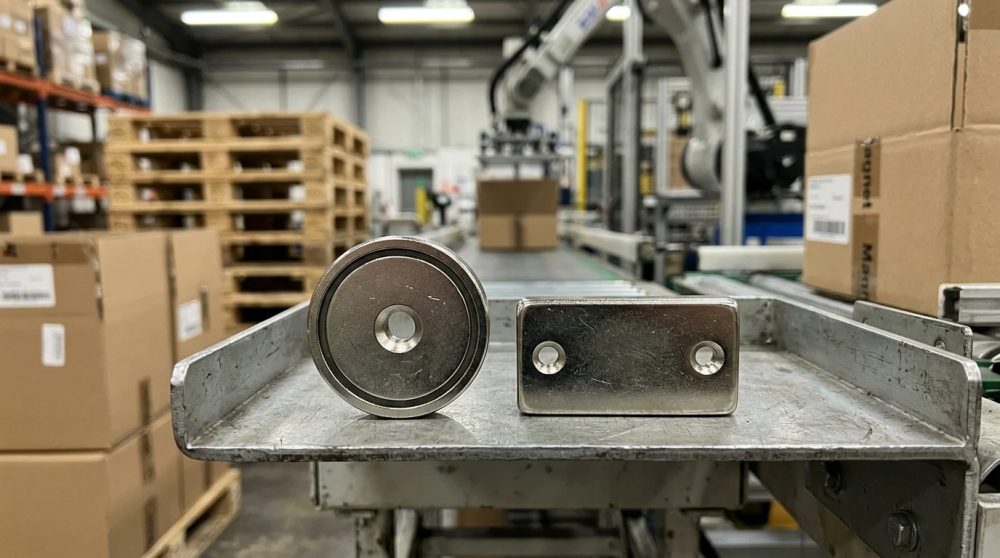
While both geometries utilize the same fundamental principles of magnetic flux redirection, their distinct physical shapes necessitate different approaches to internal circuit design, material selection, and mounting configurations. Understanding these structural differences is critical for optimizing performance in specific industrial environments.
How magnetic circuit design differs
The magnetic circuit in a pot magnet relies on the steel shell to act as a flux return path, concentrating the magnetic energy at the working face. In a round pot magnet, this creates a symmetric, 360-degree flux distribution. The central pole (usually the magnet itself) and the outer pole (the rim of the steel cup) generate a highly concentrated, localized magnetic field that is exceptionally strong upon direct contact. The flux density in the steel rim of a Neodymium (NdFeB) round pot magnet frequently reaches saturation levels between 1.2 and 1.4 Tesla.
Rectangular pot magnets often utilize a different internal architecture. Instead of a single central pole, they frequently employ a multi-pole or bi-pole configuration, sometimes alternating multiple rectangular block magnets with steel spacers. This design stretches the magnetic field along the longitudinal axis, creating a wider, more distributed flux pattern. While this may slightly reduce the peak localized pull force compared to a round magnet of equivalent volume, it provides a broader active holding area that is advantageous for gripping uneven or elongated steel surfaces.
Materials, mounting options, and size standards
Both shapes utilize standard commercial magnetic materials, predominantly Neodymium (NdFeB) for maximum strength, Ferrite for cost-sensitive or high-temperature applications, and Samarium Cobalt (SmCo) for extreme thermal stability. However, their mounting options diverge based on geometry. Round pot magnets frequently feature centralized mounting solutions, such as countersunk holes for flathead screws, internal threaded bosses, or external threaded studs ranging from M4 to M12 standard metric threads.
Rectangular pot magnets typically require dual or multiple mounting points to ensure stability along their length. They often incorporate two or more countersunk holes or through-holes spaced evenly across the steel channel. In terms of standardization, round magnets are ubiquitous, with catalog diameters scaling incrementally from 10 mm up to heavy-duty 100 mm variants. Rectangular standards are less rigid but commonly revolve around standard widths of 10 mm to 30 mm, with lengths extending up to 120 mm to accommodate various linear profiles.
Performance Comparison of Round and Rectangular Pot Magnets
Performance evaluation of pot magnets requires analyzing both vertical pull force and lateral shear resistance. Because the steel shell focuses the magnetic field so tightly, even minor variations in geometry, surface contact, and operational alignment can yield significant fluctuations in holding capacity.
Pull force, shear resistance, and stability
When measuring pure axial pull force—the resistance to being pulled straight off a flat steel plate—round pot magnets generally offer the highest performance-to-volume ratio. The radial symmetry perfectly concentrates the flux lines. For example, a standard 32 mm diameter NdFeB round pot magnet can routinely achieve a vertical pull force of up to 35 kg (approximately 343 Newtons).
However, pot magnets are notoriously weak in shear (sliding) resistance, typically holding only 15% to 20% of their rated vertical pull force before sliding down a vertical surface. Here, rectangular pot magnets demonstrate a distinct advantage. Their elongated footprint and multi-point mounting configurations increase the surface friction area and resist the pivoting motion that often precipitates sliding. A rectangular pot magnet can often achieve a shear-to-pull ratio of 20% to 30%, making them superior for wall-mounted fixtures or track guides where lateral stability is paramount.
Surface contact, air gap, and alignment tolerance
The concentrated magnetic field of any pot magnet is highly sensitive to air gaps. Introducing an air gap of just 0.5 mm—whether through paint, rust, or uneven surfaces—can degrade the vertical pull force by 40% to 50%. Round pot magnets are particularly sensitive to bridging gaps on curved surfaces, such as pipes or cylinders, unless specifically machined with a matching concave radius.
Rectangular pot magnets exhibit different alignment tolerances. Because their magnetic field is distributed along a linear axis, they can sometimes bridge minor surface irregularities better than a tightly focused round magnet. However, if a rectangular magnet is mounted slightly off-axis relative to a targeted steel track, the misalignment can cause a disproportionate loss of contact area, severely reducing holding power. Precise linear alignment is necessary to maximize their surface contact.
Comparison table for common load profiles
To clearly illustrate the operational trade-offs, the following table compares the typical performance profiles of standard round and rectangular pot magnets under identical environmental conditions.
| Performance Metric | Round Pot Magnet | Rectangular Pot Magnet |
|---|---|---|
| Primary Strength Profile | Maximum vertical pull force | Enhanced shear resistance & anti-rotation |
| Typical Shear-to-Pull Ratio | 15% - 20% | 20% - 30% |
| Standard Machining Tolerance | ±0.1 mm (lathe turned) | ±0.05 mm (CNC milled) |
| Spatial Efficiency | Optimal in radial/cylindrical cavities | Optimal in linear/cornered channels |
| Flux Distribution | Highly localized, symmetric | Elongated, distributed |
Manufacturing, Sourcing, and Compliance Considerations
Transitioning from prototype to mass production requires a thorough assessment of the manufacturing supply chain. The geometric differences between round and rectangular magnets directly influence machining times, quality control protocols, and global logistics.
Tooling, machining, plating, and assembly complexity
The complexity of the steel shell dictates the manufacturing timeline. Round cups are efficiently produced on automated lathes or via deep-draw stamping. This radial manufacturing approach can reduce active machining time by up to 40% compared to rectangular channels. Rectangular shells require CNC milling to achieve precise 90-degree internal corners, or progressive die stamping which demands significant upfront tooling capital.
Plating and finishing also present distinct challenges. Most NdFeB pot magnets receive a tri-layer Nickel-Copper-Nickel (Ni-Cu-Ni) coating, typically applied at a thickness of 10 to 20 microns. Round magnets tumble easily in barrel plating processes, ensuring an even coating. Rectangular magnets, with their sharp edges and corners, are more susceptible to uneven plating thickness and require careful handling or rack plating to prevent chipping and ensure uniform corrosion resistance.
Quality control, corrosion protection, and compliance
Quality control protocols for magnetic assemblies are stringent. Top-tier manufacturers align their Quality Management Systems with standards established by organizations like ISO, particularly ISO 9001. For pot magnets, corrosion resistance is verified through Salt Spray Testing (SST). Standard Ni-Cu-Ni plated assemblies are typically required to withstand 48 to 72 hours of continuous SST without showing red rust.
In high-volume production, defect rates must be tightly controlled, with many automotive and aerospace buyers demanding failure rates below 500 Parts Per Million (PPM). Rectangular pot magnets generally experience slightly higher defect rates during the assembly phase, as the precise insertion of multiple magnet blocks into a tight steel channel poses a greater risk of chipping the brittle NdFeB material compared to dropping a single disc into a round cup.
Packaging density, freight efficiency, and supplier capability
Logistics and freight efficiency also factor into the total landed cost. Rectangular pot magnets offer superior packaging density. Because they tessellate perfectly, a standard master export carton (e.g., 35 x 25 x 15 cm) can hold approximately 12% to 15% more rectangular magnets by volume than round magnets, which inherently leave void spaces between cylinders. This denser packaging can marginally reduce per-unit shipping costs.
However, dense packaging of strong magnets requires robust magnetic shielding to comply with international freight regulations. Under IATA rules for air freight, packages containing magnetic materials must not exceed specific magnetic field emissions at a distance of 2.1 meters, and master cartons are typically capped at a 20 kg gross weight limit to ensure safe handling and compliance. Suppliers must balance the high packaging density of rectangular magnets with these strict weight and shielding limitations.
How to Choose Between Round and Rectangular Pot Magnets
Specifying the correct pot magnet requires a systematic evaluation of mechanical, environmental, and financial constraints. By analyzing the specific demands of the end-use application, buyers can navigate the trade-offs between the raw pulling power of round magnets and the structural stability of rectangular variants.
Step-by-step selection process
The selection process should follow a sequential engineering assessment. First, calculate the required load, distinguishing between pure vertical pull and lateral shear forces. Second, evaluate the mounting environment: determine if the assembly process favors drilling a standard cylindrical recess or milling a linear groove. Third, identify environmental constraints, such as standard maximum operating temperatures (typically 80°C for standard NdFeB grades, though specialized grades can exceed 150°C).
Finally, conduct a total cost of ownership analysis. While round magnets may offer a lower unit cost and lower tooling fees, a rectangular magnet might eliminate the need for secondary anti-rotation pins or complex mounting brackets, ultimately reducing the total assembly cost.
| Selection Criteria | Favor Round Pot Magnet | Favor Rectangular Pot Magnet |
|---|---|---|
| Mounting Cavity Preparation | Standard drilled hole | CNC milled linear groove |
| Primary Load Profile | Pure axial (vertical) pull | High shear or torsional loads |
| Production Volume & Budget | High volume, strict tooling budget | Custom integration, higher tooling budget |
| Positional Alignment | Self-centering is acceptable | Strict directional alignment is required |
Applications that favor each shape
Certain industries naturally gravitate toward specific shapes based on historical performance data.
Key Takeaways
- The most important conclusions and rationale for Pot Magnet
- Specs, compliance, and risk checks worth validating before you commit
- Practical next steps and caveats readers can apply immediately
Frequently Asked Questions
When should I choose a round pot magnet?
Choose a round pot magnet for drilled holes, counterbores, and general-purpose assemblies. It installs quickly, needs no rotational alignment, and is usually the most cost-effective option for standard industrial mounting.
When is a rectangular pot magnet the better option?
Use a rectangular pot magnet in linear channels, milled grooves, or corner-fitting designs. Its shape uses space more efficiently and helps resist twisting in applications with vibration or torsional loads.
Does a round pot magnet always have stronger holding force?
Not always. Round pot magnets often deliver higher peak pull on flat contact surfaces, but rectangular pot magnets can provide better practical holding across longer or uneven steel areas because their magnetic field is spread over a wider face.
How do cost and MOQ typically differ between round and rectangular pot magnets?
Round versions are usually cheaper and commonly start around 500–1,000 units. Rectangular versions often need more complex tooling, so MOQs may start near 2,000 units and unit prices can be 15%–30% higher in smaller runs.
Can RCMAGNET help select the right pot magnet shape for my project?
Yes. At rcmagnet.com, you can match shape selection to your mounting method, load direction, material, and quantity. Share your groove or hole dimensions and target pull force to get a more accurate recommendation.