 EN
EN AR
AR HR
HR CS
CS DA
DA NL
NL FI
FI FR
FR DE
DE EL
EL IT
IT JA
JA KO
KO NO
NO PL
PL PT
PT RU
RU ES
ES SV
SV IW
IW VI
VI TH
TH TR
TR FA
FA MS
MS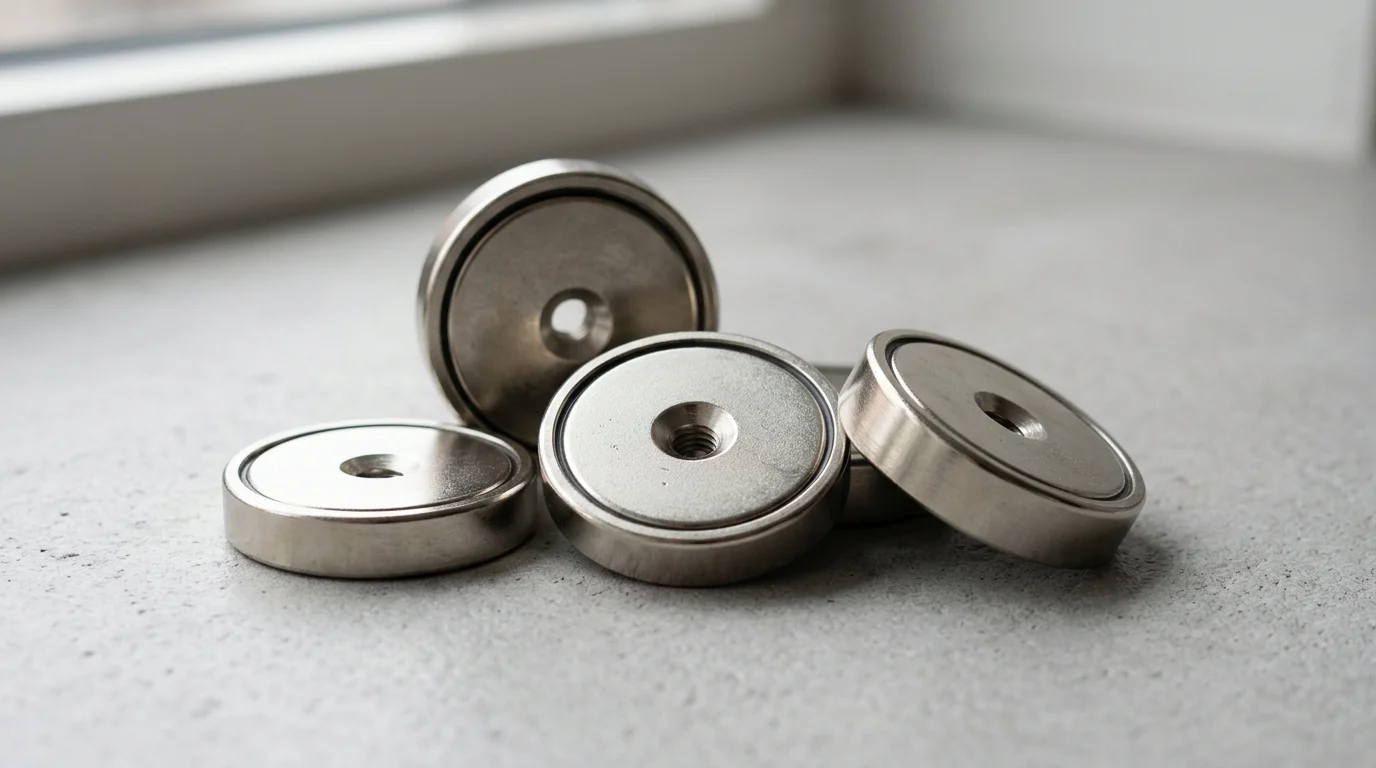
A welding fixture is only as effective as its ability to hold parts accurately, quickly, and without getting in the welder’s way. Neodymium pot magnets solve a common workholding problem by delivering concentrated holding force from a compact, mountable assembly, making them especially valuable for sheet metal, brackets, frames, and robotic welding cells. This article explains how pot magnets improve setup speed, repeatability, and fixture accessibility, while also clarifying their limits around heat, shear loads, and heavy weldments. It also covers practical selection factors—pull force, mounting style, contact conditions, and hybrid use with clamps—so fixture builders can design safer, faster, and more consistent workholding systems.
Why Pot Magnets Matter in Welding Fixtures
In modern fabrication and manufacturing environments, efficiency and precision are paramount. Neodymium pot magnets have emerged as indispensable components in welding fixtures and workholding systems, altering how engineers approach jig design. Unlike standard bare magnets, pot magnets consist of a neodymium-iron-boron (NdFeB) magnet encased in a steel shell or "pot." This structural integration focuses the magnetic flux onto a single active face, delivering exceptional holding force relative to the magnet's physical footprint and making them ideal for securing workpieces in constrained spaces.
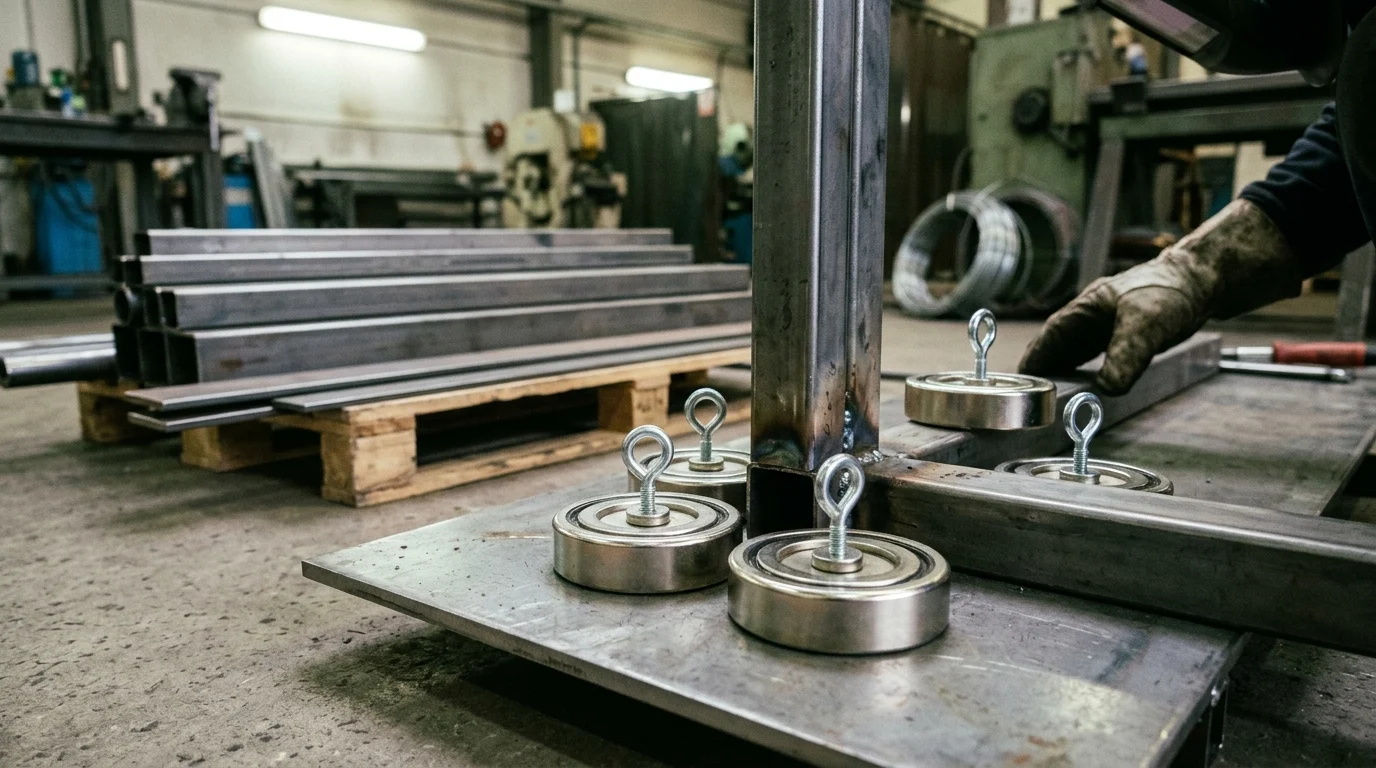
The integration of these magnetic assemblies addresses critical challenges in welding operations, primarily concerning component stabilization prior to tacking. Traditional mechanical clamping requires physical clearance for clamps, toggles, and operator hands, which can obstruct the welding torch and complicate automated robotic weld paths. By embedding pot magnets directly into the fixture base or backing plates, engineers can achieve a zero-clearance hold. A relatively small neodymium pot magnet can exert hundreds of Newtons of direct pull force, providing sufficient rigidity to stabilize sheet metal and structural profiles without interfering with the primary weld zone.
Improve Fixture Speed and Repeatability
The primary operational advantage of integrating pot magnets into welding fixtures is the substantial reduction in setup and teardown times. In high-volume production, the cycle time dedicated to loading and unloading workpieces often exceeds the actual arc-on welding time. Pot magnets facilitate drop-and-lock positioning: operators simply place the steel component against the magnetic datum, and it is instantly secured. This rapid actuation can significantly reduce tack welding setup times compared to traditional manual toggle clamping, directly increasing throughput.
Furthermore, pot magnets enhance positional repeatability. Because the magnetic force pulls the workpiece flush against the precision-machined face of the magnet and fixture stops, it minimizes human error associated with uneven clamping pressure. When recessed into a fixture plate with tight machining tolerances, pot magnets contribute to highly consistent part placement. This consistency is critical in robotic welding cells, where even minor deviations can lead to weld defects, burn-through, or missed seams.
Use Pot Magnets with Clamps and Jigs
While highly effective, pot magnets are rarely used in isolation for complex or heavy-duty welding assemblies. Expert fixture design relies on a hybrid approach, combining the instantaneous holding power of pot magnets with the absolute rigidity of mechanical clamps and jigs. In these hybrid systems, pot magnets act as the primary locators and temporary stabilizers. They hold the various components—such as gussets, brackets, or sheet panels—in the correct orientation, freeing the operator's hands to apply heavier mechanical clamps or activate pneumatic workholding cylinders.
This collaborative use is particularly important when dealing with the immense localized heat of continuous welding. While a neodymium pot magnet provides excellent initial holding force, the thermal expansion forces of thick steel plates can exceed the magnet's shear resistance. Therefore, best practices dictate using pot magnets to maintain alignment during the initial tack welding phase, followed by the application of heavy-duty toggle clamps or hydraulic swing clamps to lock the assembly rigidly in place before the final structural welds are applied.
How Neodymium Pot Magnets Work
To effectively integrate neodymium pot magnets into industrial workholding, engineers must understand the underlying physics of their construction. A bare neodymium magnet emits a diffuse magnetic field that travels through the air from its north pole to its south pole. A pot magnet alters this dynamic by embedding the NdFeB material inside a carbon steel cup. The steel housing acts as a highly permeable conduit for the magnetic field, capturing the flux lines that would normally radiate outward and redirecting them to the open face of the assembly.
This redirection creates a closed-loop magnetic circuit when a ferrous workpiece bridges the gap between the magnet's center and the steel cup's outer rim. Because the magnetic energy is concentrated at this single interface, the direct pull force of a pot magnet is often three to four times greater than that of a bare magnet of identical volume. Additionally, the steel cup provides critical mechanical protection, shielding the brittle sintered neodymium from impacts, abrasions, and the harsh physical environment typical of a welding shop.
Steel Housing and Magnetic Force
The relationship between the internal magnet and the steel housing dictates the overall performance of the assembly. The thickness of the steel cup must be precisely engineered to match the magnetic grade of the internal NdFeB disc. If the steel wall is too thin, it will reach magnetic saturation, allowing flux to leak through the sides and reducing the holding power at the active face. If the cup is too thick, it unnecessarily increases the weight and footprint of the fixture.
Another critical function of the steel housing is magnetic isolation. In complex welding jigs packed with sensors, pneumatic lines, and delicate electronic controls, stray magnetic fields can cause interference or attract metallic debris to unwanted areas. The steel pot effectively confines the magnetic field to the designated clamping face, rendering the sides and back of the magnet assembly magnetically inert. This allows the pot magnet to be bolted directly into steel fixture plates without magnetizing the entire jig or inadvertently disrupting nearby proximity sensors.
Pull Force, Shear Force, Air Gap, and Temperature
Engineers must distinguish between direct pull force and shear force when designing magnetic workholding. The advertised rating of a pot magnet refers strictly to its direct pull force perpendicular to a thick, flat, unpainted steel surface. However, in vertical orientations where gravity acts parallel to the magnet face, the holding capacity is governed by shear force. Due to the low coefficient of friction between smooth steel and the magnet face, the shear force is typically only 20% to 30% of the rated pull force.
Air gaps and operating temperatures further degrade magnetic performance. An air gap is any non-magnetic material between the magnet and the workpiece, including paint, rust, mill scale, or actual physical distance. Because the magnetic circuit relies on the steel cup, even a microscopic air gap severely disrupts the flux path.
| Air Gap (mm) | Pull Force Retention (%) | Effective Force for 500N Magnet (N) |
|---|---|---|
| 0.00 | 100% | 500 |
| 0.50 | 45% | 225 |
| 1.00 | 25% | 125 |
| 2.00 | 10% | 50 |
Temperature is equally critical in welding applications. Standard neodymium magnets suffer reversible loss of magnetism as temperatures rise and will suffer permanent, irreversible demagnetization if they exceed their maximum operating temperature, typically 80°C (176°F). For welding fixtures exposed to high heat, engineers must specify high-temperature grades. Magnets with "SH" (Super High), "UH" (Ultra High), or "EH" (Extreme High) suffixes modify the NdFeB alloy, pushing the maximum operating threshold up to 150°C, 180°C, or even 200°C respectively.
Pot Magnets vs Other Workholding Options
Selecting the optimal workholding mechanism requires a rigorous comparison of available technologies. While neodymium pot magnets offer unique advantages, they compete directly with traditional mechanical toggle clamps, switchable permanent magnets, and electromagnets. Each system presents distinct trade-offs regarding holding capacity, actuation speed, energy consumption, and capital expenditure. Understanding these operational parameters ensures that fixture designers deploy the most cost-effective and reliable solution for their specific production demands.
The decision often hinges on the physical characteristics of the workpiece itself. Magnetic workholding is heavily dependent on the thickness of the target material. A powerful pot magnet requires a steel workpiece thick enough to absorb all the magnetic flux. If applied to thin sheet metal, the material will saturate, and excess magnetic flux will pass through the part into the air, resulting in a drastically reduced holding force. In contrast, mechanical clamps apply consistent physical pressure regardless of the material's thickness or magnetic permeability.
Compare Holding Force, Setup Time, and Cost
When comparing holding force density, neodymium pot magnets are unmatched. They provide immense holding power in a highly compact footprint, which is critical for dense multi-part assemblies. However, their actuation speed presents a practical trade-off; while placement is instantaneous, removing a strongly magnetized part requires physical leverage or sliding. This difficulty in part removal can slow down unloading if not properly accounted for in the jig design. Switchable permanent magnets solve this by allowing the field to be turned off via a mechanical lever, though they are significantly bulkier.
Cost analysis heavily favors standard pot magnets for static fixture points. They provide a highly economical solution compared to the capital expenditure required for heavy-duty mechanical toggle clamps, switchable permanent magnets, or industrial electromagnets.
| Workholding Method | Relative Initial Cost | Actuation Speed | Holding Force Density | Power Requirement |
|---|---|---|---|---|
| Neodymium Pot Magnet | Low | Instant (<1s) | Extremely High | None |
| Toggle Clamp (Mechanical) | Moderate | Fast (1-2s) | Moderate | None |
| Switchable Permanent Magnet | High | Moderate (2-3s) | High | None |
| Electromagnet | Very High | Instant (<1s) | High | Continuous (DC) |
Electromagnets offer the distinct advantage of automated, instant release via programmable logic controllers (PLCs), making them ideal for fully automated robotic cells. However, they require continuous direct current to maintain their hold. If power is interrupted, the workpiece is dropped. Neodymium pot magnets provide fail-safe holding power without any electrical infrastructure, eliminating the risk of dropped parts during power outages.
When to Use Pot Magnets, Clamps, or Electromagnets
The specific application dictates the appropriate technology. Pot magnets are the undisputed choice for sheet metal fabrication, automotive body-in-white assemblies, and light-to-medium bracket welding. In these scenarios, the primary goal is rapid stabilization of multiple thin-gauge components before tacking. The low profile of pot magnets ensures they do not obstruct the TIG or MIG welding torch, allowing for continuous, unbroken weld seams along the edges of the assembly.
Conversely, heavy structural steel fabrication often requires heavy mechanical clamps or switchable lifting magnets. The sheer mass of these components, combined with the extreme thermal distortion generated by multi-pass structural welding, can overpower the shear resistance of standard pot magnets. In automated setups where the fixture must physically eject the welded part upon completion, electromagnets or pneumatically actuated mechanical clamps are strictly required, as standard permanent pot magnets would prevent automated part ejection.
How to Specify Pot Magnets for Welding
Specifying the correct pot magnet for a welding fixture is a precise engineering exercise that goes beyond simply selecting the highest pull force available. Over-equipping a fixture with excessively powerful magnets makes part removal dangerously difficult for operators and can inadvertently magnetize the workpieces, which in turn causes arc blow during TIG or MIG welding. Conversely, underspecifying the magnets risks part shifting during the welding process, leading to scrapped assemblies.
A rigorous specification process accounts for the physical load of the component, the geometric orientation of the magnet, the environmental hazards of the welding cell, and the mechanical integration method. By calculating exact requirements and applying appropriate safety factors, fixture designers can ensure reliable, repeatable holds that withstand the rigors of high-volume industrial fabrication.
Calculate Load and Safety Factor
The first step in specification is calculating the required load and applying an appropriate engineering safety factor. Because catalog pull-force ratings are derived under ideal laboratory conditions, real-world applications will inevitably see reduced performance. Surface roughness, minor warping of the raw material, and thin-gauge stock all degrade the actual holding force.
For direct pull applications (where gravity or force acts perpendicular to the magnet face), engineers should apply a minimum safety factor of 2:1. For example, to hold a 100 N plate securely against a ceiling fixture, specify a magnet rated for at least 200 N. However, for shear load applications (where the part is held against a vertical face), a safety factor of 4:1 to 5:1 is mandatory due to the low friction coefficient. To hold that same 100 N part vertically, the specified pot magnet must have a direct pull rating of at least 400 N to 500 N to prevent downward sliding.
Manage Heat, Spatter, Vibration, and Side Load
Welding environments introduce severe operational hazards: extreme localized heat, molten spatter, and mechanical vibration. Managing heat requires specifying high-temperature NdFeB grades to prevent irreversible flux loss and mitigate the cumulative effects of thermal cycling. If the magnet is positioned near the primary weld zone, conductive heat transfer through the fixture plate must be calculated, and thermal breaks (such as ceramic or phenolic spacers) should be integrated into the mounting design.
Weld spatter poses a significant threat to magnetic workholding. Molten steel droplets are inherently attracted to the magnetic field and will aggressively fuse to the exposed magnet face. This creates an immediate and severe air gap, destroying the magnet's holding power for subsequent cycles. To mitigate this, engineers should specify pot magnets with stainless steel housings or utilize thin, non-magnetic sacrificial covers (like brass or ceramic tape) over the magnet face, factoring the thickness of the cover into the air gap calculations.
Vibration from grinding, chipping, or automated part handling also threatens fixture integrity. Neodymium is a brittle ceramic material; repeated high-impact shocks can shatter the magnet inside its housing or cause cumulative demagnetization. Therefore, the pot magnet must be securely retained. Relying solely on friction fits or industrial adhesives is insufficient in heavy fabrication; mechanical fastening through the steel pot is required to manage vibration and side loads.
Choose Threaded, Countersunk, or Stud Mounts
The method of mechanical integration dictates the physical style of the pot magnet chosen. Countersunk pot magnets are the most common in flat fixture plates. They feature a central conical hole designed to accept standard flathead machine screws. When installed, the screw head sits flush with the magnet face, allowing the workpiece to lay perfectly flat against the assembly. This style is ideal for surface-mounting on existing jigs.
Internal threaded stud (female) pot magnets feature a blind threaded hole on the back of the steel cup. These are utilized when the magnet must be mounted from behind the fixture plate, concealing the fastener and leaving the entire magnetic face completely smooth and uninterrupted. This is particularly useful for preventing spatter buildup in fastener recesses.
External threaded stud (male) pot magnets feature a threaded rod protruding from the back of the cup. These are highly versatile for creating adjustable standoffs or mounting to slotted brackets. By utilizing locking nuts on the threaded stud, operators can precisely adjust the height (Z-axis) of the magnet to establish perfectly level datum points for complex, three-dimensional weldments.
How Buyers Should Select Reliable Pot Magnets
For procurement professionals and manufacturing engineers, sourcing reliable neodymium pot magnets is critical to maintaining production uptime. The global supply chain for rare earth magnets is highly fragmented, with significant variances in quality control, material purity, and performance consistency. Purchasing solely based on the lowest unit cost often results in premature fixture failure, increased scrap rates, and hidden operational costs.
Procurement involves evaluating the true lifecycle cost of the workholding components, verifying the manufacturer's quality assurance processes, and ensuring that the specific magnet design matches the technical requirements of the welding cell. Buyers must establish vendor qualification protocols to filter out suppliers who misrepresent magnetic grades or utilize substandard steel housings.
Check Material Grade, Coating, and Quality Control
When auditing a magnet supplier, buyers must first verify the material grade and coating specifications. Standard industrial pot magnets should feature a robust Nickel-Copper-Nickel (Ni-Cu-Ni) triple-layer coating to protect the NdFeB material from oxidation. While zinc coatings are cheaper and offer decent corrosion resistance, they have lower temperature thresholds and are less durable under repeated mechanical impacts.
Quality control documentation is essential. Reliable manufacturers should operate under ISO 9001 standards and provide detailed testing reports, including B-H curve demagnetization data and guaranteed flux density measurements. For precision fixture integration, mechanical dimensional tolerances are just as critical as magnetic strength. Buyers should insist on tight dimensional tolerances for the outer diameter of the steel pot to ensure a precise interference or slip fit into machined fixture recesses.
Evaluate Lifecycle Cost and Fixture Reusability
While high-temperature, tightly toleranced pot magnets carry a higher initial purchase price, their lifecycle cost in a reusable fixture is highly efficient. Consider a standard tacking operation: using disposable welded tacking tabs or complex single-use jigs incurs continuous material and labor costs. Conversely, a high-temperature pot magnet integrated into a modular fixture might be cycled thousands of times over a production run, reducing the amortized cost per cycle to a fraction of a cent.
Buyers should also evaluate the modularity and reusability of the magnets across different product lines. Standardizing procurement around a few specific pot magnet sizes allows tooling departments to bulk-purchase at lower minimum order quantities, streamlining inventory management and reducing overall tooling expenditures for custom or high-grade assemblies.
Key Takeaways
- Use neodymium pot magnets as zero-clearance locators when conventional clamps would block the welding torch, operator access, or robotic weld path.
- Recess pot magnets into precision-machined fixture plates so the workpiece is pulled flush against fixed datums for more repeatable tack and weld positioning.
- Combine pot magnets with mechanical, pneumatic, or toggle clamps for heavy weldments because thermal expansion and shear loads can exceed magnetic holding capacity.
- Select pull force using real fixture conditions, including air gaps, steel thickness, surface finish, vibration, and load direction, rather than relying only on ideal catalog values.
- Choose mounting styles such as threaded, straight-hole, or compact housed pot magnets based on fixture plate design, maintenance access, and required holding strength.
- Work with an experienced supplier such as Richeng when custom NdFeB assemblies, testing support, or production-ready magnetic workholding components are required.
Frequently Asked Questions
What makes a neodymium pot magnet different from a bare magnet?
A pot magnet places an NdFeB magnet inside a steel housing, which concentrates magnetic flux on one active face. This gives high holding force in a compact size and protects the magnet better than an exposed bare magnet.
Can pot magnets replace mechanical clamps in welding fixtures?
Usually, they work best with clamps rather than replacing them completely. Pot magnets are excellent for fast positioning and temporary stabilization, while mechanical, pneumatic, or toggle clamps provide extra rigidity during heavy welding and thermal expansion.
How do pot magnets improve fixture speed and repeatability?
They support drop-and-lock loading, so steel parts are held as soon as they contact the magnetic datum. When recessed into accurately machined fixture plates, they help pull parts flush and reduce variation caused by uneven manual clamping.
Are neodymium pot magnets suitable near welding heat?
They can be used in welding fixtures, but direct heat exposure should be managed. Excessive temperature can reduce neodymium magnet strength, so fixture designers should use spacing, shielding, heat-resistant layouts, and supplemental clamps where needed.
How should I choose the right pull force for a workholding magnet?
Consider part weight, contact area, steel thickness, air gaps, surface finish, vibration, and shear forces. Catalog pull force is typically measured under ideal direct-pull conditions, so use a safety factor and test in the real fixture.