 EN
EN AR
AR HR
HR CS
CS DA
DA NL
NL FI
FI FR
FR DE
DE EL
EL IT
IT JA
JA KO
KO NO
NO PL
PL PT
PT RU
RU ES
ES SV
SV IW
IW VI
VI TH
TH TR
TR FA
FA MS
MSOutline
- What causes demagnetization in industrial equipment
- How material grade and temperature rating affect stability
- Why pot-style structures improve practical holding force
- How installation, corrosion control, and maintenance reduce loss
- How to select the right product for different industrial scenarios
What Causes Neodymium Magnet Demagnetization in Industrial Equipment?
Demagnetization happens when heat, reverse fields, or poor magnetic circuit design push a magnet beyond its stable operating range. For neodymium magnet systems, temperature is the most common trigger because elevated heat weakens coercivity and can cause irreversible loss.
Industry references consistently note that permanent magnet performance depends on both material properties and the surrounding magnetic circuit. IEC 60404-18:2025 also formalizes measurement methods for permanent magnet properties and correction of self-demagnetizing effects, which shows why geometry matters as much as raw material data.
In practice, industrial equipment creates stress through vibration, friction, intermittent overload, and nearby electrical components. These conditions do not always destroy magnetism immediately, but they can accelerate gradual loss if the design margin is too small.
How Can a Neodymium Magnet Stay Stable at High Temperature?
Temperature control is the most effective way to prevent demagnetization in industrial equipment. The magnet should be selected with a working temperature rating that exceeds the highest expected service temperature, not the average ambient temperature.
Higher-temperature grades are designed for tougher environments, but grade selection must still match the load profile. A magnet that performs well in room-temperature holding may lose stability in a hot motor housing, a welding fixture, or a sun-exposed outdoor assembly line.
According to industry estimates, many field failures occur because users compare static pull force instead of thermal margin. That approach is incomplete, since a magnet with strong initial force can still degrade quickly if it operates too close to its maximum temperature.
Key temperature-control practices
- Choose a grade with sufficient coercivity for the application.
- Avoid direct contact with heat sources whenever possible.
- Allow airflow or heat dissipation around the assembly.
- Use thermal barriers or isolation parts when the machine runs hot.
Why Does Magnetic Circuit Design Matter So Much?
Magnetic circuit design is a major reason pot-style assemblies outperform bare magnets in real industrial use. A steel shell concentrates flux toward the working face, which increases effective holding force and also shields the magnet from impact damage.
That is why a pot magnet often delivers better practical performance than an exposed magnet of similar material and size. The steel housing guides magnetic lines of force and reduces side leakage, so the contact surface receives more usable attraction. For industrial equipment, this matters because the magnet is rarely used in perfect alignment. A better magnetic circuit can tolerate small gaps, rough surfaces, and repeated mounting cycles more effectively than a bare block magnet.
Comparison Table: Bare Magnet vs Pot Magnet in Industrial Equipment
| Feature | Bare Neodymium Magnet | Pot Magnet Assembly |
|---|---|---|
| Flux direction | More leakage around the sides | Flux concentrated at the working face |
| Mechanical protection | Low | High, due to steel shell |
| Practical holding force | Depends heavily on contact quality | Usually stronger on a target surface |
| Resistance to damage | More vulnerable to chipping | Better protected during handling |
Which Installation Methods Reduce Demagnetization Risk?
Installation method affects both reliability and magnet life because it determines how stress enters the assembly. A countersunk design suits screw mounting, while a straight-hole design is better for bolt or rod fixation in mechanical structures.
When the magnet is fixed securely, it experiences less vibration, less edge impact, and fewer alignment shifts. That reduces the chance of chipping and helps preserve the magnetic circuit under repeated industrial use. For example, pot magnet product options are often chosen when stable mechanical fastening is required.
Rubber-coated designs are useful when the contact surface must be protected from scratches or slippage. They are not always the strongest option for raw pull force, but they can improve friction and reduce surface wear in equipment that moves frequently.
Key Specifications for Industrial Magnet Selection
| Selection Factor | What to Check | Why It Matters |
|---|---|---|
| Temperature rating | Maximum service temperature | Prevents irreversible thermal loss |
| Mounting style | Countersunk, straight hole, or bonded | Affects vibration resistance and alignment |
| Coating | Nickel, epoxy, or rubber protection | Improves corrosion and surface durability |
| Magnetic circuit | Open magnet or steel-cased design | Changes usable holding force |
How Does Corrosion Protection Help Prevent Performance Loss?
Corrosion protection is essential because neodymium materials are sensitive to moisture and many industrial contaminants. Once the coating is damaged, oxidation can spread and weaken the magnet’s structure, especially in humid, outdoor, or chemical-exposure environments.
Protective coatings do not increase magnetism directly, but they preserve the material that produces it. In that sense, coating quality is a reliability feature, not just a cosmetic finish. For wet or abrasive environments, sealed or coated assemblies are usually more durable than unprotected magnets.
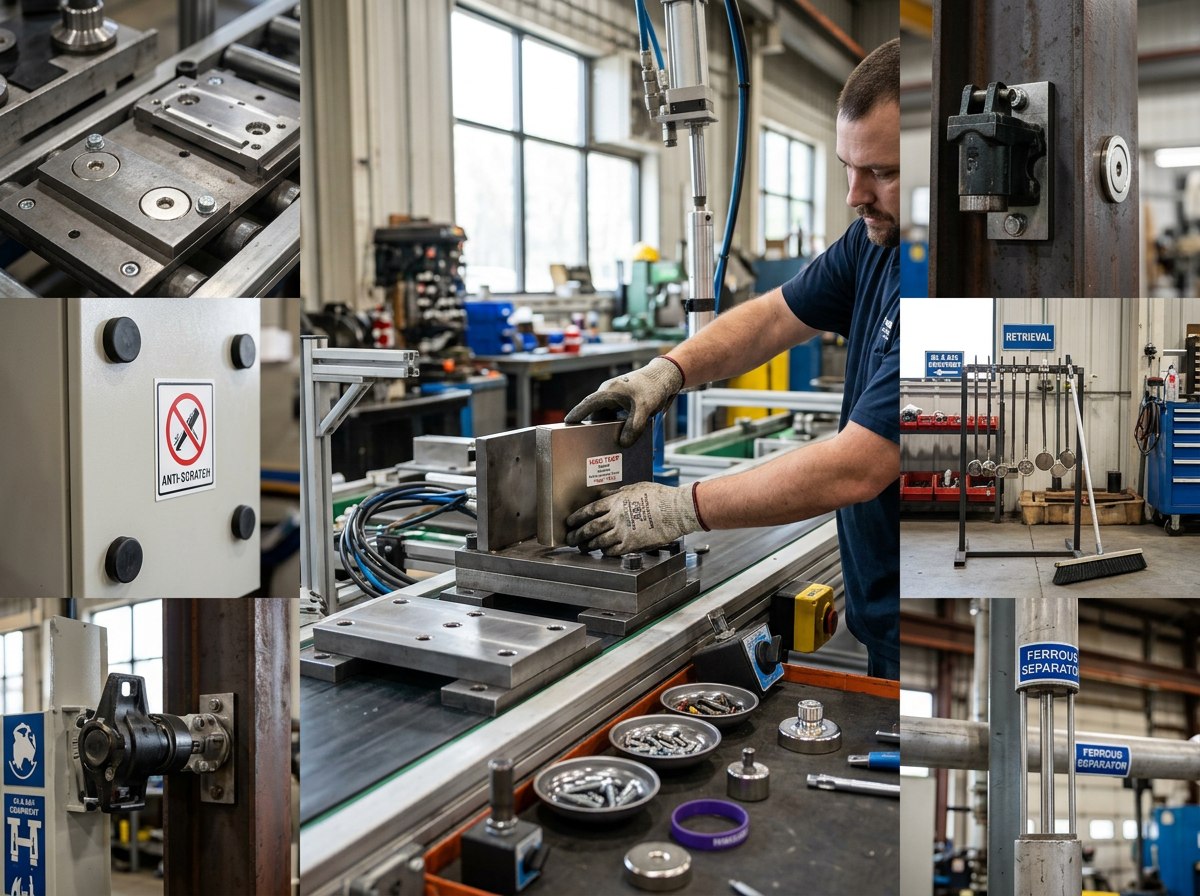
Industrial users should also inspect contact surfaces regularly. Dirt, rust, and metal chips can create a gap between the magnet and the workpiece, which lowers effective holding force and can be mistaken for demagnetization.
What Maintenance Practices Extend Magnet Life?
Routine inspection is one of the simplest ways to avoid unexpected magnet loss in industrial equipment. A magnet should be checked for coating damage, loose fasteners, surface contamination, and visible chipping during scheduled maintenance.
Cleaning matters because debris changes the working gap and can create uneven loading. In workshops and fabrication areas, a magnetic sweeper or pickup tool can help remove iron filings before they interfere with fixtures or separators.
Maintenance teams should also avoid exposing magnets to uncontrolled heat during repair. Welding sparks, oven cycles, and high-friction grinding can all raise local temperature enough to reduce stability, even if the surrounding machine seems safe.
Maintenance Checklist
- Inspect the coating and shell for cracks or corrosion.
- Remove chips, dust, and ferrous debris from the contact face.
- Verify that screws, bolts, and housings remain tight.
- Keep magnets away from unnecessary heat during servicing.
- Replace assemblies that show repeated loss of holding force.
Where Are These Magnets Used Most Often?
Industrial applications determine the right anti-demagnetization strategy because each environment creates different stress. Welding fixtures need angle stability, separators need consistent capture, and retrieval tools need durability under impact and contamination.
For assembly and maintenance work, magnetic pickup tools reduce lost fasteners and speed up cleanup. For submerged or hard-to-reach recovery tasks, fishing magnets are built for harsher conditions and require stronger structural support.
In filtration and process lines, magnetic rods and separators protect downstream equipment by capturing ferrous contaminants. In these systems, stability is not only about pull force; it is also about maintaining consistent capture over long operating cycles.
Application Table: Common Industrial Uses and Main Risk Factors
| Application | Main Risk Factor | Best Protection Strategy |
|---|---|---|
| Welding fixtures | Heat and spatter | Use heat-aware placement and shielding |
| Magnetic separation | Contamination and abrasion | Use coated or enclosed assemblies |
| Pickup and recovery tools | Impact and corrosion | Choose rugged housings and coatings |
| General mounting | Vibration and misalignment | Use secure mechanical fastening |
Supplier Directory: Where to Buy Industrial Magnetic Solutions
Supplier selection should focus on product fit, engineering support, and documentation quality rather than pull-force claims alone. A useful supplier can explain grade, temperature margin, coating choice, and mounting method in the same specification set.
For a broad product range, the main product catalog is a practical starting point because it covers neodymium material, pot-style assemblies, retrieval tools, separation components, and mounting accessories. That range helps buyers compare structural options within one sourcing process.
When evaluating any supplier, ask for operating temperature limits, coating details, and installation guidance. Those three items usually reveal whether the product is designed for real industrial duty or only for simple static holding.
FAQ
1. What is the main reason a neodymium magnet loses strength in industrial equipment?
Heat is the most common cause, especially when the magnet operates near or above its rated temperature. Mechanical shock, corrosion, and strong opposing fields can also contribute. In many cases, the problem is not sudden failure but gradual irreversible loss from repeated stress.
2. Are pot magnets better than bare magnets for preventing demagnetization?
Pot magnets are often better in industrial use because the steel shell protects the magnet and concentrates flux at the working face. They do not eliminate thermal risk, but they usually improve practical durability, mounting stability, and real-world holding performance compared with exposed magnets.
3. Does a higher pull force mean better resistance to demagnetization?
Not necessarily. Pull force measures attraction under specific test conditions, while demagnetization resistance depends on coercivity, temperature margin, and magnetic circuit design. A magnet with lower initial pull force may last longer if it is better matched to the working environment.
4. How can corrosion lead to magnet performance loss?
Corrosion damages the magnet body and coating, which can reduce structural integrity and create gaps at the contact face. Once the surface degrades, the effective holding force drops and the assembly becomes more vulnerable to further wear, especially in humid or chemical environments.
5. What should buyers ask before choosing a magnet for industrial equipment?
They should ask about maximum operating temperature, coating type, mounting method, and expected working environment. It is also important to confirm whether the product is a bare magnet, a pot assembly, or a coated design, because each behaves differently under load.