 EN
EN AR
AR HR
HR CS
CS DA
DA NL
NL FI
FI FR
FR DE
DE EL
EL IT
IT JA
JA KO
KO NO
NO PL
PL PT
PT RU
RU ES
ES SV
SV IW
IW VI
VI TH
TH TR
TR FA
FA MS
MS- Choose a supplier that can explain holding force, mounting style, and corrosion protection in application terms.
- Verify whether the product uses a steel cup, countersunk hole, threaded insert, or rubber coating for the target environment.
- Ask for test methods, dimensional tolerances, coating specs, and lead-time consistency before you place a production order.
- For industrial projects, the best supplier is not always the cheapest one; it is the one that reduces failure risk.
Finding a reliable custom pot magnet supplier matters because a pot magnet is not just a magnet, but a complete magnetic assembly engineered for real industrial use. The steel cup focuses the magnetic flux, which is why a properly designed pot magnet can deliver far better usable holding force than a bare magnet of similar material and size. In industrial projects, this difference affects fixture stability, tool retention, equipment safety, and long-term maintenance. If your design must balance compact size, corrosion resistance, and repeatable mounting, you need a supplier who can translate technical specifications into a dependable industrial magnetic solution, not just ship catalog stock. For quality context, many manufacturers align dimensional verification and fit checks with general measurement practices such as ISO 230-1:2022 for machine tool accuracy concepts and with coating performance expectations based on ASTM B117 salt spray testing when corrosion exposure is a concern.
What a Custom Pot Magnet Supplier Must Prove First
The first sign of a trustworthy custom pot magnet supplier is the ability to explain why the product works in your exact environment. A strong supplier should be able to distinguish between nominal magnet strength and usable holding force on your actual contact surface. That difference matters because holding force changes with steel thickness, surface roughness, air gap, coating thickness, and the direction of load. A supplier who only quotes a static pull number without asking about your substrate, orientation, or safety factor is not yet engineering your project.
Industrial buyers should also expect the supplier to speak clearly about magnetic grade, cup geometry, and operating temperature. Neodymium magnets are common for compact high-force designs because they offer high energy density, but they also need correct coating selection and temperature control. Standard neodymium grades can begin to lose performance when the application exceeds their temperature rating, so a supplier should identify whether your project needs standard, high-temperature, or epoxy-protected options. For corrosive locations, surface protection is not cosmetic; it is part of service life planning.
| Supplier Checkpoint | What to Ask | Why It Matters |
|---|---|---|
| Magnetic design | How does the steel cup change flux concentration? | It determines usable holding force on the target surface. |
| Mounting method | Countersunk, threaded, or plain bore? | It affects installation speed and retention stability. |
| Surface protection | Nickel, epoxy, zinc, or rubber coating? | It changes corrosion resistance and contact safety. |
| Temperature rating | What is the maximum working temperature? | Heat can reduce magnet performance and bond reliability. |
| Quality evidence | What test reports or inspection records are available? | It shows repeatability, not just sample quality. |
Why Pot Magnet Supplier Selection Depends on Application, Not Catalog Claims
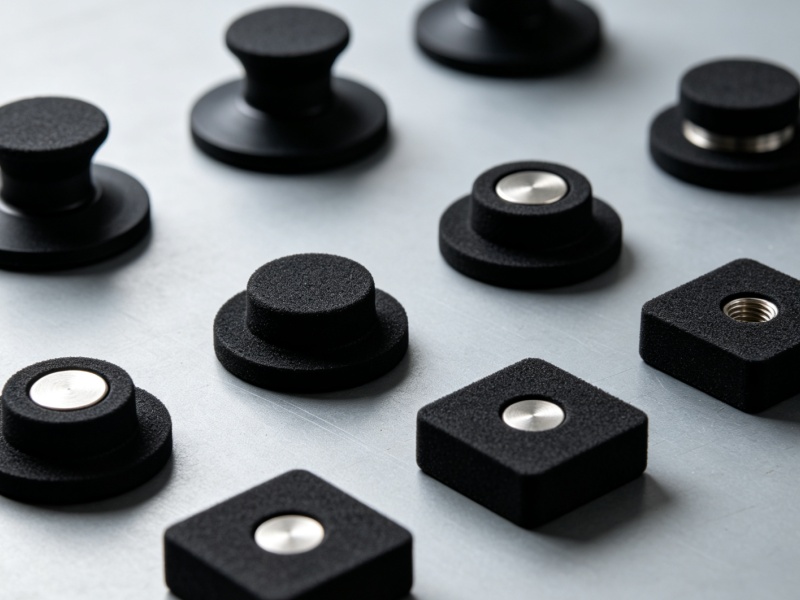
Application fit is the real filter when choosing a pot magnet supplier. The same product can perform very differently in a fixture, a hook mount, a machine cover, or a maintenance tool. A countersunk pot magnet is usually best for screw-fixed installation, while a threaded or straight bore version is more suitable for stud mounting, hooks, or custom assemblies. If your design needs contact-surface protection, a rubber-coated format can reduce scratching and improve friction stability, which is useful on painted panels, finished steel surfaces, or mobile equipment.
The best suppliers ask about the load path, not just the load value. A vertical pull on a flat clean plate is not the same as side loading, vibration, or repeated impact. In real industrial use, the functional load is often lower than the published pull force because of paint, curvature, dust, or oil film. That is why custom pot magnet sourcing should include a safety factor. In many practical designs, engineers apply a safety margin of 2x to 5x depending on motion, vibration, and risk level. The exact factor should be determined by your internal engineering rules and test results, but the principle is simple: never choose solely by headline pull force.
| Mounting Style | Best Use Case | Typical Advantage | Limitation |
|---|---|---|---|
| Countersunk hole | Screw-fixed assemblies | Simple installation | Requires aligned fastener head |
| Threaded insert | Hooks, standoffs, fixture parts | Easy integration | More assembly components |
| Straight bore | Rod or bolt mounting | Flexible mechanical fit | Needs precise hardware selection |
| Rubber coated | Painted or polished surfaces | Scratch reduction | Lower temperature tolerance than bare metal versions |
If your project involves frequent repositioning, the supplier should also discuss wear. A pot magnet with a well-made steel cup is more mechanically protected than a bare magnet, because the shell absorbs incidental contact damage during handling and assembly. That protection is especially valuable in production tooling and mobile workstations, where repeated placement and removal can chip unprotected magnet edges.
How to Evaluate Quality Data From a Pot Magnet Supplier
A reliable supplier should present quality data in a format that supports engineering decisions. At minimum, ask for dimensional tolerances, coating details, temperature limits, and test conditions for holding force. The number on a product page is only meaningful if you know the test plate, surface finish, contact condition, and pull direction. Without those variables, the quoted force can be misleading.
For coating durability, many buyers use salt spray testing as a screening reference. ASTM B117 is widely used as a corrosion test method, and while salt spray time does not directly equal field life, it helps compare surface protection under controlled conditions. If a supplier cannot identify the coating system or test approach, that is a warning sign for outdoor, marine, chemical, or humid indoor applications. For dimensional control, industrial buyers should also confirm whether the supplier measures key features such as countersunk angle, bore diameter, outer diameter, and thickness at an agreed inspection level.
| Data Type | What You Need | Typical Decision Impact |
|---|---|---|
| Pull force | Test plate, thickness, and load direction | Determines whether the magnet can hold the part safely |
| Coating | Nickel, Zn, epoxy, rubber, or custom finish | Affects corrosion resistance and surface compatibility |
| Temperature limit | Maximum operating range in degrees Celsius | Affects demagnetization risk and bond stability |
| Dimensional tolerance | Outer diameter, height, hole size, angle | Affects fit, assembly, and interchangeability |
| Inspection method | Sampling or full inspection plan | Affects batch consistency and rejection risk |
When you compare suppliers, look for consistency across batches rather than a single sample. The strongest sign of maturity is not a perfect prototype; it is a supplier who can reproduce the same geometry, coating, and performance on repeat orders. That is especially important if the magnet will be built into tooling or consumer products that require stable appearance and fit.
Where Custom Pot Magnet Suppliers Add Real Value in Industrial Projects
Customization creates value when it solves a real engineering constraint. In many industrial projects, the default catalog part is close but not quite right. The supplier then adds value by changing the mounting hole, adjusting the cup dimensions, selecting a different coating, or recommending a rubber-coated variant for delicate surfaces. This is where a good custom magnet solutions page becomes useful, because it should show how design changes map to use cases instead of listing products in isolation.
For manufacturing teams, a custom pot magnet can simplify fixture design, reduce auxiliary hardware, and shorten setup time. For maintenance teams, it can improve portability and reduce lost tools. For warehouse and general industrial use, it can support hooks, signs, covers, and quick-change mounts. For special projects such as fishing recovery, oilfield retrieval, or inspection tools, the supplier may need to adjust magnet size, assembly strength, and coating resistance to fit harsher conditions. In those cases, engineering support matters more than catalog variety.
- Ask whether the supplier can recommend the right cup shape for your load direction.
- Confirm whether the magnet will contact painted, plated, or raw steel surfaces.
- Check if the supplier can adapt the hole pattern or thread type to your assembly.
- Request a sample before mass production, then validate it under real use conditions.
A supplier with real customization capability should also discuss failure modes. For example, if the magnet is exposed to lateral shock, the retention may depend more on friction than pull force. If the part will sit near heat-generating equipment, the coating and adhesive system must be stable under the expected thermal load. These are not optional details; they determine whether the magnet is a robust component or a recurring maintenance issue.
Technical Comparison of Pot Magnet Options for Industrial Design
Different pot magnet structures serve different engineering priorities. The right choice depends on whether you need compact force, easy fastening, scratch protection, or a special shape for assembly. A supplier should be able to explain these options clearly and recommend the least risky design for your use case.
| Pot Magnet Type | Best For | Design Benefit | Common Constraint |
|---|---|---|---|
| Countersunk pot magnet | Screw-fixed mounting | Fast installation | Needs exact screw alignment |
| Threaded pot magnet | Hooks and modular fixtures | Easy mechanical integration | Extra component cost |
| Rubber-coated pot magnet | Delicate surfaces | Reduced scratching and better grip | Lower heat resistance than bare steel versions |
| Deep cup design | Higher flux concentration | Improved usable holding force | Can be larger or heavier |
Flux concentration is the key mechanism behind pot magnet performance. The steel cup provides a return path for the magnetic circuit, so more magnetic flux is directed toward the contact face instead of leaking around the sides. This is why two magnets made from the same neodymium grade can behave differently in practice. The assembly design matters as much as the magnet material itself.
Industrial buyers should also pay attention to material pairing. A high-grade magnet inside a poor-quality shell does not create a reliable product. Cup steel quality, plating adhesion, insert fixation, and machining accuracy all influence field performance. That is why experienced buyers ask for both material specification and process control, not only a price quote.
How to Audit a Pot Magnet Supplier Before You Place an Order
A practical supplier audit is usually faster than a costly field failure. Start by asking for specification sheets, test conditions, coating details, and production lead time. Then compare those documents against your actual use case. If the supplier can answer basic questions about temperature, corrosion, and installation without hesitation, that is a positive sign. If they need to “check with the factory” on every technical point, the supply chain may not be ready for industrial volume.

You should also ask how the supplier handles samples and repeat orders. Industrial projects often fail because the sample looks good but the production batch shifts in geometry or coating quality. A dependable supplier can explain lot traceability, inspection methods, and any material substitutions. For B2B procurement, direct communication reduces ambiguity and shortens the correction cycle, especially when custom dimensions are involved.
- Confirm the product type, mounting method, and intended substrate.
- Request technical drawings or dimensional photos before sampling.
- Ask for coating and corrosion information relevant to your environment.
- Validate sample performance under real load, vibration, and temperature.
- Lock the acceptance criteria before production order release.
Industry buyers should also pay attention to service responsiveness. The best supplier is one that can answer technical questions quickly and clearly, because industrial schedules are rarely forgiving. If your project has a narrow launch window, a responsive factory-direct source can reduce the risk of missing integration milestones. That is one reason many buyers prefer a direct factory profile page that explains production scope, engineering support, and business model.
How Pot Magnet Performance Should Be Tested in Real Projects
Real project testing should reproduce the actual installation and loading conditions as closely as possible. A lab pull test on clean flat steel can be useful, but it is only the starting point. The real question is whether the pot magnet still performs after paint, dust, vibration, repeated handling, and environmental exposure are added. That is why engineers should verify the magnet in the final assembly, not only in isolation.
For example, a magnet used on a machine guard may require repeated attachment cycles without coating wear. A magnet used in a field tool may need to survive dirt, impact, and moisture. A magnet used on a retail fixture may need lower scratch risk and cleaner appearance. These are different acceptance standards, even if the base product family is the same. Industrial project solutions work best when the test plan matches the real risk.
If your application is especially sensitive, ask the supplier about sample orientation, pull direction, and the test fixture used to measure force. The more transparent the test method, the easier it is to compare vendors. Also consider whether the supplier can support custom packaging, batch labeling, and traceability for multi-site procurement. Those details matter when the project scales beyond pilot volume.
Common Mistakes When Choosing a Pot Magnet Supplier
The most common mistake is buying by pull-force number alone. A second mistake is ignoring corrosion exposure until after the product reaches the field. A third mistake is using the wrong mounting style, which creates installation risk or weak retention. A fourth mistake is assuming all neodymium magnets behave the same in a steel cup, when geometry, plating, and assembly quality can change actual performance significantly.
Buyers also often underestimate the importance of communication. A supplier who understands industrial terminology can help you avoid hidden errors such as choosing a countersunk design when a threaded insert would reduce assembly time, or specifying a bare magnet when a rubber-coated version would protect the contact surface. These are small choices with large consequences over a long production run.
- Do not accept an unlabeled pull-force claim without test conditions.
- Do not ignore moisture, salt, chemicals, or temperature when choosing coating.
- Do not specify the wrong mounting type for your assembly process.
- Do not skip sample validation in the actual operating environment.
- Do not assume one magnet shape fits every industrial use case.
FAQ: Choosing a Reliable Custom Pot Magnet Supplier
1. What makes a pot magnet different from a bare magnet?
A pot magnet uses a steel cup to concentrate magnetic flux and protect the magnet body, which usually increases usable holding force and improves mechanical durability.
2. How do I know if a pot magnet supplier is reliable?
A reliable supplier can explain test conditions, mounting styles, coatings, and temperature limits clearly, and can support samples with repeatable production quality.
3. Is pull force the only number I should care about?
No. Holding performance also depends on substrate thickness, surface condition, load direction, vibration, and environmental exposure.
4. When should I choose a rubber-coated pot magnet?
Choose rubber coating when you need scratch protection, better friction, or softer contact on finished surfaces, but check temperature and chemical resistance first.
5. Why is corrosion protection important for industrial magnets?
Because moisture, salt, chemicals, and outdoor exposure can degrade both the coating and the magnetic assembly over time, reducing service life.
6. What is the best mounting style for industrial projects?
It depends on the application. Countersunk is common for screw fixing, threaded inserts suit modular hardware, and straight bores fit rod or bolt mounting.
7. Should I ask for samples before ordering in volume?
Yes. Sample testing in the real environment is one of the best ways to confirm fit, holding performance, and durability before production release.
In short, the best custom pot magnet supplier is the one that reduces technical uncertainty. If the supplier can explain the magnetic circuit, show production discipline, and match the mount, coating, and performance to your industrial project, you are far more likely to get a stable result. For teams that need a broader view of product families, a structured magnetic tools category can also help compare related solutions such as magnetic hooks, trays, sweepers, and fixtures under one procurement strategy.