 EN
EN AR
AR HR
HR CS
CS DA
DA NL
NL FI
FI FR
FR DE
DE EL
EL IT
IT JA
JA KO
KO NO
NO PL
PL PT
PT RU
RU ES
ES SV
SV IW
IW VI
VI TH
TH TR
TR FA
FA MS
MS- Magnetic bases are best when stability, repeatable placement, and tool mounting matter most.
- Magnetic brackets are better for angled support, compact layouts, and light-to-medium holding tasks.
- Selection should consider pull force, coating, heat resistance, and installation method, not just magnet size.
- Workstation efficiency improves when magnetic accessories reduce part loss, repositioning time, and clutter.
For workstation support, the strongest decision rule is simple: choose a magnetic base for stable mounting and a magnetic bracket for flexible positioning. In industrial magnet design, a steel cup or shell can concentrate magnetic flux and increase effective holding force versus an exposed magnet of the same material, which is why cup-style assemblies are widely used in support hardware. For precision applications, standards such as ISO 230-1:2022 are often referenced in machine-tool positioning contexts, while contact safety and handling expectations should align with NIST guidance and the engineering realities of the work cell. If you are comparing options on magnetic bases, magnetic brackets, or broader neodymium magnet assemblies, the right answer depends on how the station is used, not only on raw pull force.
Magnetic Base vs Magnetic Bracket: What Each One Does Best
A magnetic base is optimized to create a stable anchor point on a steel surface.
It is the better option when the workstation needs indicator arms, gauges, lamps, camera mounts, or positioning fixtures that must stay put during repeated use.
A magnetic bracket is optimized to hold or support an object at an angle, often with a smaller footprint and faster repositioning.
That makes it useful for light fixtures, cable routing, signage, auxiliary supports, and temporary holding tasks around a workstation.
| Feature | Magnetic Base | Magnetic Bracket |
|---|---|---|
| Primary function | Stable mounting | Angled or compact support |
| Typical use | Indicators, gauges, lamps | Light fixtures, support arms, holders |
| Repositioning speed | Medium | High |
| Footprint | Larger | Smaller |
| Best for | Repeatable workstation setup | Flexible layout changes |
In other words, if the operator expects to move the accessory often but still wants reliable support, the bracket can be the more practical choice.
If the accessory must hold alignment with low drift over time, the base usually wins.
Why Magnetic Base Performance Is About the Magnetic Circuit
Magnetic support performance is determined by the magnetic circuit, not by magnet material alone.
A cup-style or shell-style assembly can direct flux into the contact face and improve usable holding force compared with an unshielded magnet of the same size and grade.
This is why many workstation-support products use steel housings, plated surfaces, and carefully designed contact geometry.
That design also protects the magnet from chipping, impact, and abrasion during routine installation.
| Design factor | Why it matters | Workstation impact |
|---|---|---|
| Steel shell or cup | Concentrates flux | Higher effective holding force |
| Plating or coating | Improves corrosion resistance | Better life in humid or oily environments |
| Contact surface flatness | Reduces air gap | More consistent pull force |
| Mechanical protection | Lowers chip risk | Safer handling and longer service life |
For workstation users, the key takeaway is that a well-designed magnetic base can outperform a bare magnet even when both use the same neodymium core.
That is especially important on painted, slightly curved, or imperfect steel surfaces where air gaps reduce real-world holding power.
How to Choose the Right Workstation Support by Load and Surface
The correct choice depends on load direction, not just weight.
Magnetic holding is strongest in direct pull and weaker in shear, so a support used on a vertical panel behaves differently from one used on a horizontal machine bed.
This is why a magnetic base may feel secure in axial pull but still slip if the workstation sees vibration or side loading.
For that reason, the best selection process starts with the actual force direction, surface finish, and mounting angle.
| Selection factor | Magnetic Base | Magnetic Bracket | Decision rule |
|---|---|---|---|
| Direct pull load | Strong | Moderate | Base preferred |
| Side load or vibration | Moderate | Moderate | Use mechanical backup if critical |
| Frequent repositioning | Good | Very good | Bracket preferred |
| Compact layout | Fair | Strong | Bracket preferred |
| Precision alignment | Strong | Fair | Base preferred |
If the workstation is a metrology bench, a tooling area, or a repair station, stability usually matters more than aesthetics.
If the station changes often, a bracket reduces setup friction and makes the layout easier to adapt.
Material, Coating, and Temperature Limits Matter More Than Buyers Expect
Magnet grade, coating, and heat exposure can change real performance dramatically.
Neodymium magnets are popular because they deliver high magnetic energy density in a compact form, but they are also sensitive to temperature and corrosion without proper protection.
According to common industry specifications, NdFeB grades such as N35, N42, and N52 indicate different energy product levels, with higher grades generally delivering stronger pull in a similar footprint.
For many neodymium systems, maximum operating temperature depends on grade and formulation, often ranging from about 80 C for standard grades to 150 C or higher for high-temperature versions, according to manufacturer datasheets.
That is why a workstation near welding, soldering, or hot tooling should not choose support hardware by size alone.
| Parameter | Typical value | Why it matters |
|---|---|---|
| Neodymium grade | N35 to N52 | Higher grade generally means higher pull in the same volume |
| Standard operating temperature | About 80 C | Heat can reduce magnetization |
| High-temperature variants | Up to 150 C or more | Better for hot work areas |
| Common coatings | Nickel, epoxy, rubber | Controls corrosion and surface damage |
If the support contacts painted aluminum, stainless, or coated steel, consider an accessory with a rubber interface or protective pad.
That can improve grip stability while reducing scratches on the workstation surface.
Workstation Use Cases: When a Magnetic Base Wins and When a Magnetic Bracket Wins
A magnetic base wins when the workstation needs repeatable accuracy.
Examples include dial indicators on machine tables, inspection arms, task lights, and small sensor fixtures that must remain steady while the operator works around them.
A magnetic bracket wins when the workstation needs speed and flexibility.
Examples include temporary cable support, small signs, accessory holders, and angled utility mounts on assembly lines or repair benches.
In assembly and maintenance environments, magnetic accessories can reduce small-part loss and minimize unnecessary trips to retrieve tools or hardware.
For stations that handle screws, washers, or fittings, magnetic storage and pickup tools can improve organization, especially when the work involves frequent handoffs.
- Use a magnetic base for inspection, measurement, and alignment tasks.
- Use a magnetic bracket for temporary support and adjustable layouts.
- Use protective coatings when the surface is painted, polished, or corrosion-prone.
- Use mechanical backup if the supported object is safety-critical.
What Real-World Pull Force Means in Practice
Pull force numbers only make sense when the test conditions are known.
Manufacturer pull ratings are usually measured under ideal conditions on thick, clean, flat low-carbon steel with direct contact and no air gap.
In a real workstation, paint, curvature, dirt, and vibration reduce the usable force, sometimes substantially.
That is why a support product should be selected with a safety margin instead of a raw number alone.

| Condition | Effect on holding force | Buyer action |
|---|---|---|
| Clean flat steel | Highest | Use catalog rating as baseline |
| Paint or coating | Lower | Increase margin |
| Curved surface | Lower | Check contact geometry |
| Vibration | Lower | Prefer wider base or mechanical lock |
A practical rule is to avoid sizing a workstation support at the edge of its rating.
Leaving headroom makes the setup more tolerant of dust, repeated placement, and operator handling.
Installation Methods: Threaded, Through-Hole, and Bracketed Support
Installation style often decides the product before magnet strength does.
Threaded interfaces are common when the user wants a screw-on mount for an arm, clamp, or accessory head.
Through-hole or straight-hole structures are better when the design needs a rod, bolt, or pin to pass through the assembly.
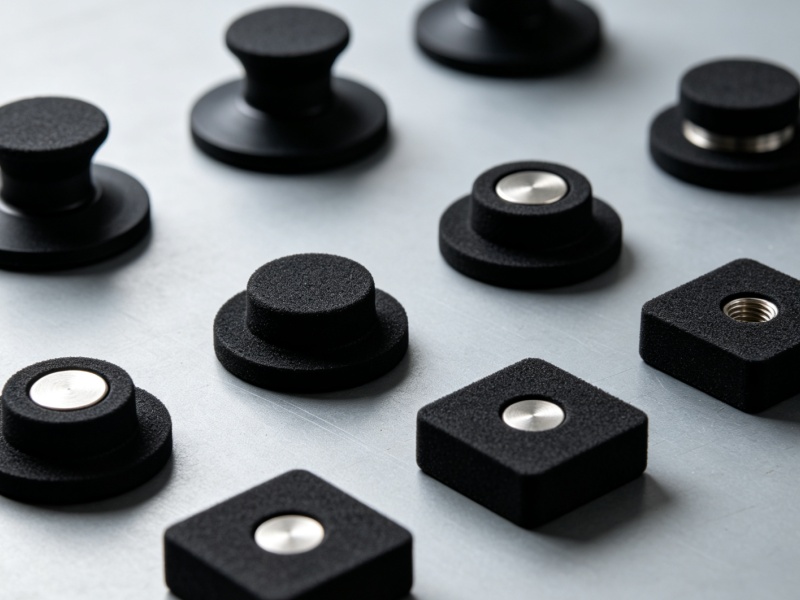
Counterbored or countersunk designs are useful when the fastener head must sit flush and avoid interfering with the workstation surface.
- Choose threaded mounting for rigid, repeatable attachment.
- Choose through-hole mounting for rods, bolts, or pass-through assembly.
- Choose countersunk designs when flush contact is important.
- Choose rubber-faced support when surface protection matters.
These installation details are often the difference between a support that works once and one that works every shift.
That is why workstation buyers should ask how the part installs before asking how strong it is.
Compliance and Verification: How Engineers Test Magnetic Support Hardware
Reliable magnetic support should be verified under controlled conditions, not guessed from appearance.
Engineering teams often evaluate contact surface quality, pull direction, and environmental exposure before approving a workstation accessory.
For measurement and alignment applications, the tolerance mindset behind ISO 230-1:2022 is relevant because even a small position shift can affect repeatability.
For safety and handling contexts, companies often reference public technical guidance from NIST and material data from resources such as MatWeb when checking steel grades, coatings, or temperature limits.
Manufacturers and buyers should also confirm corrosion resistance through salt-spray or equivalent environmental testing, especially if the workstation is exposed to moisture or cleaning chemicals.
For magnet assemblies used in industrial hardware, a direct, repeatable test method is more valuable than a generic marketing claim.
How to Decide in Three Steps
The fastest choice process is to start with function, then move to geometry, then move to environment.
- Define the job: stable mounting or flexible support.
- Check the load path: direct pull, side load, vibration, or frequent repositioning.
- Match the environment: temperature, corrosion, paint, and surface flatness.
If the first answer is “measurement or fixed alignment,” the magnetic base is usually the safer pick.
If the first answer is “temporary hold or compact support,” the magnetic bracket is usually more efficient.
Common Mistakes Buyers Make
The most common mistake is treating all magnetic support products as interchangeable.
Another mistake is ignoring the real contact surface and assuming a catalog pull number will hold on a painted, curved, or dirty workstation panel.
A third mistake is using a support product near heat without checking the magnet grade and coating.
A fourth mistake is overlooking how often the station will be reconfigured, which directly affects whether a base or bracket is the better fit.
- Do not buy on size alone.
- Do not ignore air gaps or paint layers.
- Do not assume all coatings resist chemicals equally.
- Do not skip the installation interface.
When those mistakes are avoided, magnetic workstation accessories become far more reliable and much easier to justify operationally.
Recommended Product Direction for Different Workstations
The best product choice depends on whether the workstation is inspection-focused, assembly-focused, or maintenance-focused.
For inspection benches, a magnetic base is usually best because repeatable position control matters more than speed.
For assembly cells, a magnetic bracket is often better because layout flexibility and quick changes matter more than exact alignment.
For maintenance carts, the choice can go either way, but a bracket often wins if the user is moving tools and parts constantly.
For mixed-use industrial cells, a hybrid strategy often works best: a base for precision accessories and a bracket for temporary or lightweight support.
| Workstation type | Best choice | Reason |
|---|---|---|
| Inspection bench | Magnetic base | Alignment stability |
| Assembly cell | Magnetic bracket | Fast layout changes |
| Maintenance cart | Magnetic bracket | Portability and quick repositioning |
| Measurement station | Magnetic base | Repeatable positioning |
If you are sourcing related hardware, it is worth comparing support products with broader magnetic solutions such as cup magnets and magnetic hooks, because the best mounting architecture is often a system decision, not a single part decision.
FAQ
Which is stronger for workstation support, a magnetic base or a magnetic bracket?
A magnetic base is usually stronger for stable support because it is designed for direct mounting and repeatable positioning.
Which is better for frequent repositioning?
A magnetic bracket is usually better because it is compact and easier to move between locations.
Can a magnetic base hold a tool arm or indicator steadily?
Yes, if the surface is flat, clean, and made of suitable steel, and if the support is rated with enough margin.
Do coatings affect workstation support performance?
Yes, coatings can improve corrosion resistance, but thick paint or soft coatings can also reduce effective magnetic contact.
What magnet grade is common in compact support products?
Neodymium grades such as N35 to N52 are commonly used because they provide high magnetic energy in a small size.
What should I check before buying magnetic support hardware?
Check pull direction, mounting style, surface condition, temperature, and whether the load will experience vibration or side force.
When should I use a mechanical backup instead of only magnetic support?
Use mechanical backup when the object is safety-critical, heavily vibrated, or could cause damage if it shifts.