 EN
EN AR
AR HR
HR CS
CS DA
DA NL
NL FI
FI FR
FR DE
DE EL
EL IT
IT JA
JA KO
KO NO
NO PL
PL PT
PT RU
RU ES
ES SV
SV IW
IW VI
VI TH
TH TR
TR FA
FA MS
MS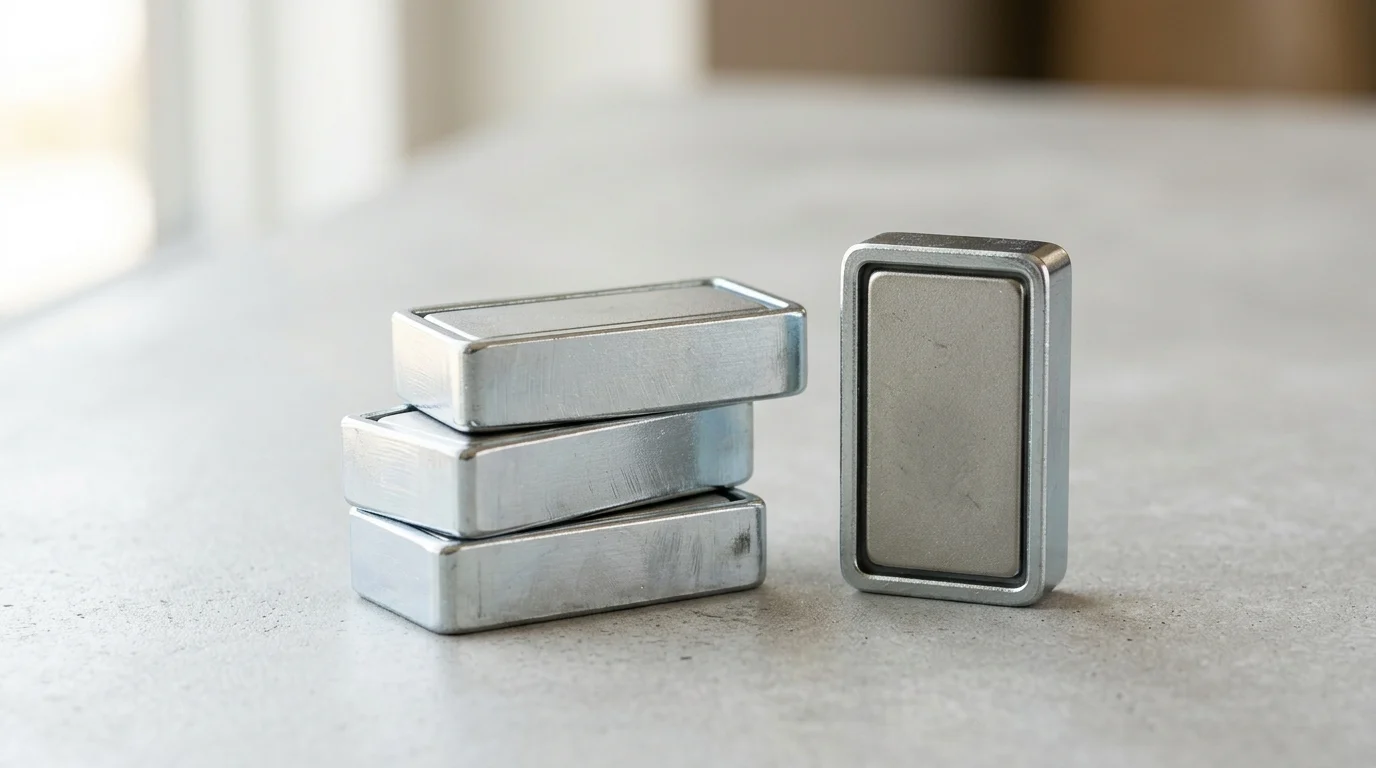
In fixture and tooling design, a few millimeters of space can determine whether a workholding solution is stable, repeatable, and safe. Rectangular pot magnets solve a specific engineering problem: they deliver concentrated magnetic holding force along a linear footprint, making them especially useful for sheet metal, brackets, profiles, robotic grippers, and compact jigs. Unlike raw magnets, these assemblies use a steel housing to protect the magnetic core and direct flux toward the working face. This article explains how their geometry, holding behavior, mounting options, and real-world limits affect performance—and why design engineers should evaluate air gaps, load direction, welding proximity, and safety factors before specifying them.
Why Choose Rectangular Pot Magnets for Fixtures
Industrial fixture design demands precision, repeatability, and robust workholding solutions. When securing ferrous workpieces in confined or strictly linear spaces, rectangular pot magnets provide a critical advantage. Unlike traditional raw magnets, these specialized assemblies sit within a steel channel that amplifies holding power and provides structural integrity, making them ideal for heavy-duty manufacturing environments.
Maximizing surface area contact within strict dimensional constraints often dictates a rectangular form factor. Whether deployed in automated welding jigs, CNC machining fixtures, or robotic end-effectors, rectangular pot magnets offer a unique combination of high pull force and geometric stability.
Improving Holding Reliability
The primary advantage of rectangular pot magnets lies in their geometric resistance to rotational forces. A single round magnet allows a secured workpiece to pivot around the magnetic center if subjected to lateral machining forces. Conversely, a rectangular pot magnet establishes a linear contact patch that inherently resists torque and prevents unwanted rotation.
A standard 50 mm by 15 mm rectangular pot magnet typically generates a direct pull force of around 350 Newtons (N), depending on the specific internal magnet grade and manufacturer design. Distributing this holding force along a continuous line rather than a single point yields higher holding reliability across extended workpieces, such as sheet metal panels or structural steel profiles. This minimizes the risk of part deflection during aggressive machining or assembly operations.
Commercial Use Cases
In commercial applications, rectangular pot magnets frequently integrate into robotic welding cells to hold steel gussets and brackets flush against primary structures. While the steel channel concentrates the magnetic field on the active face and reduces stray flux compared to unshielded raw magnets, magnetic fields can still cause arc blow. Careful placement away from the immediate weld zone remains necessary to mitigate this risk.
Automated assembly lines also utilize these magnets as non-marring gripper components on robotic end-effectors. For example, lifting a 25 kg steel enclosure might require an array of four rectangular pot magnets to distribute the load safely. Even with an operational air gap of 0.5 mm caused by surface coatings or industrial debris, a properly specified rectangular assembly maintains sufficient flux density for a secure grip. However, overhead lifting applications always require a fail-safe mechanical backup, as sudden impacts or power loss (in electro-permanent variants) can cause an uncontrolled release.
What Defines Rectangular Pot Magnets
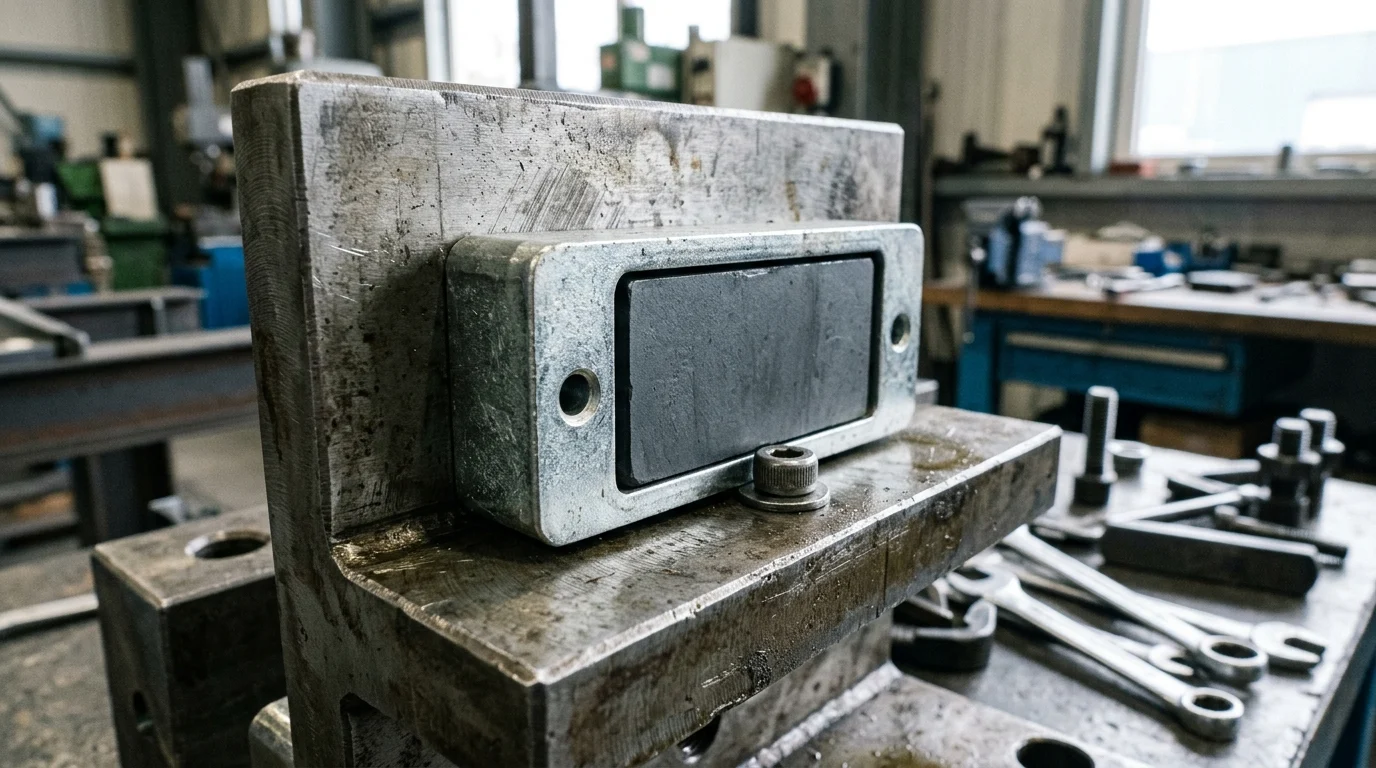
At their core, rectangular pot magnets are engineered magnetic circuits rather than simple raw materials. They consist of a permanent magnet core—typically Neodymium (NdFeB) or occasionally Samarium Cobalt (SmCo)—embedded within a U-shaped or rectangular carbon steel channel. This composite construction defines their operational characteristics and mechanical durability.
The U-channel design serves a dual purpose: it protects the brittle sintered magnet material from mechanical impacts inherent in industrial environments, and it fundamentally alters the behavior of the magnetic field to optimize workholding performance. Despite this protection, severe mechanical impacts can still cause sudden demagnetization or physical fracturing of the core material.
Steel Housing and Magnetic Flux
The steel housing is an active component of the magnetic circuit. In a standard raw magnet, the magnetic flux lines radiate from both the north and south poles, effectively splitting the available holding power. The steel channel in a rectangular pot magnet acts as a flux conductor, redirecting the magnetic field lines from the non-working faces and concentrating them exclusively at the open contact surface.
This redirection creates a multipole effect on a single face, typically increasing the effective pull force by 30% to 50% compared to a raw magnet of the exact same volume, depending on the specific design. For instance, a bare neodymium block magnet yielding a pull force of 100 N might achieve up to 150 N when encased in a precisely toleranced low-carbon steel housing. This efficiency allows for smaller, lighter magnetic assemblies without sacrificing holding capacity.
Magnet Grades, Coatings, and Mounting Options
Internal magnet grade and external surface treatments heavily dictate the performance of a rectangular pot magnet. Standard assemblies utilize N35 to N52 grade Neodymium, offering a balance of cost and extreme holding power. To combat corrosion in harsh industrial environments, the internal magnets typically receive a 10 to 20-micron layer of Ni-Cu-Ni (Nickel-Copper-Nickel) coating, while the steel housing is either zinc-plated or galvanized.
Mounting configurations further define the utility of these magnets. Standard designs feature countersunk holes, counterbored holes, or threaded studs integrated directly into the steel housing. This allows for flush mounting using standard M3 to M6 metric fasteners, ensuring the magnet does not protrude past the fixture surface. During mounting and handling, personnel need to be aware of severe pinch hazards, as these highly concentrated magnetic circuits will snap violently to nearby ferrous objects.
| Magnet Material | Common Grades | Max Operating Temp (°C) | Relative Pull Force | Primary Application |
|---|---|---|---|---|
| Neodymium (Standard) | N35 - N52 | 80°C | Very High | General automation, indoor fixtures |
| Neodymium (High-Temp) | N42SH, N38UH | 150°C - 180°C | High | Warm environments, near-weld tooling |
| Samarium Cobalt | SmCo5, Sm2Co17 | 250°C - 350°C | Moderate to High | Extreme heat, aerospace fixtures |
How to Compare Rectangular and Round Pot Magnets
Selecting between round or rectangular pot magnets depends heavily on the fixture design. While round pot magnets are the industry standard for general-purpose holding, rectangular variants offer distinct mechanical advantages in specific architectural and spatial scenarios.
Comparing the two shapes requires an analysis of footprint efficiency, load distribution, and how the magnetic field interacts with the geometry of the target workpiece. The optimal choice directly impacts the overall footprint of the fixture and the stability of the manufacturing process.
Key Performance Factors
Round pot magnets are symmetric and easy to machine into fixture plates using standard drill bits and counterbores. However, their circular footprint wastes valuable surface area when mounted along straight edges or inside narrow channels. Rectangular pot magnets mount edge-to-edge in a continuous linear array, maximizing the magnetic contact area along the perimeter of a workpiece.
Additionally, rectangular magnets excel in narrow profiles. Designing a fixture for a 15 mm wide steel flange precludes using a high-power 32 mm round magnet without significant overhang. Instead, a 10 mm by 40 mm rectangular pot magnet provides superior holding force while remaining completely concealed beneath the workpiece flange.
| Feature | Rectangular Pot Magnets | Round Pot Magnets |
|---|---|---|
| Footprint Efficiency | High (ideal for narrow/linear spaces) | Moderate (requires wider mounting area) |
| Rotational Resistance | Excellent (inherent anti-twist geometry) | Poor (single point allows pivoting) |
| Machining Integration | Requires milling for recessed pockets | Simple drilling/counterboring |
| Array Stacking | Flush edge-to-edge continuous lines | Leaves gaps between circular edges |
| Cost per Unit Force | Higher (due to complex machining/assembly) | Lower (standardized mass production) |
Load Direction, Air Gaps, and Workpiece Conditions
Load direction significantly impacts the effective holding power of any magnetic assembly. Magnetic pull force ratings assume a direct, perpendicular pull away from a thick, flat steel plate. However, practical fixture designs often apply loads parallel to the magnet face, resulting in shear forces. For both round and rectangular pot magnets, the effective shear load capacity is typically only 15% to 25% of the rated direct pull force.
Rectangular magnets can be strategically oriented to combat shear. Aligning the long axis of the magnet perpendicular to the direction of the anticipated sliding force maximizes frictional resistance. Furthermore, air gaps drastically affect performance. A mere 0.1 mm air gap—caused by paint, rust, or uneven machining—can reduce the holding force of a rectangular pot magnet by up to 20%. When comparing shapes, rectangular magnets often bridge uneven linear surfaces better than a single round magnet, maintaining a more consistent flux circuit across warped workpieces.
How to Specify and Integrate Rectangular Pot Magnets
Successful integration of rectangular pot magnets into tooling designs requires careful attention to mechanical specifications, machining tolerances, and environmental operating conditions. A magnet is only as effective as its integration into the broader mechanical assembly.
Magnetic workholding requires the same rigor applied to hydraulic or pneumatic clamping systems. This involves calculating precise payload requirements, understanding thermal degradation, and ensuring the fixture base does not inadvertently short-circuit the magnetic field.
Sizing, Placement, and Installation
Sizing and placement dictate the overall efficacy of the magnetic workholding system. Rectangular pot magnets are available in standard lengths ranging from 20 mm to over 120 mm, with widths typically between 10 mm and 30 mm. When designing recessed pockets in a fixture plate, the magnet needs to sit perfectly flush or slightly proud (by 0.05 mm to 0.1 mm) of the fixture surface to guarantee zero-gap contact with the workpiece.
Installation requires strict adherence to fastener torque limits. Because the internal neodymium magnet is brittle, over-tightening the mounting screws can crack the magnet material or distort the steel housing. For a standard M4 countersunk screw used in a rectangular pot magnet, the recommended maximum installation torque is generally limited to 2.0 to 2.5 Nm. Utilizing thread-locking compounds rather than excessive torque ensures the magnet remains secure under heavy industrial vibration.
Tolerances and Temperature Exposure
Dimensional tolerances are critical when integrating multiple rectangular magnets into a single CNC-machined fixture. High-quality rectangular pot magnets feature tight housing tolerances, typically ±0.1 mm on the outer dimensions and ±0.05 mm on the mounting hole centers. If the fixture pockets are machined too tight, thermal expansion during operation could compress and fracture the magnet.
Temperature exposure is another frequent point of failure in poorly specified fixture designs. Standard neodymium rectangular pot magnets suffer irreversible flux loss if exposed to temperatures exceeding 80°C. If the tooling is designed for injection molding or hot-stamping applications, high-temperature grades (such as N42SH) push the thermal threshold to 150°C. For extreme environments, such as aerospace brazing fixtures reaching 300°C, the internal core requires an upgrade to Samarium Cobalt, though this results in a roughly 20% reduction in baseline pull force compared to standard neodymium.
How to Source Rectangular Pot Magnets
Procuring rectangular pot magnets for industrial production lines requires a strategic approach to supplier evaluation and quality assurance. Because these components are often embedded deep within expensive tooling assemblies, premature failure can lead to significant manufacturing downtime.
Sourcing reliable magnetic components goes beyond comparing unit prices. It involves verifying specific magnetic properties, avoiding counterfeit materials, and determining whether off-the-shelf standards or custom-engineered solutions best fit the project parameters.
Quality, Compliance, and Documentation
Quality control requires verifying the actual magnetic properties of the supplied components. Procurement teams need to request BH curve testing documentation to confirm the exact grade of Neodymium or Samarium Cobalt used. Substituting a lower magnet grade is an irreversible error that drastically reduces holding force, and the market contains counterfeit NdFeB materials from unreliable suppliers that degrade rapidly under industrial stress.
To guarantee longevity, buyers also need to verify environmental durability through salt spray testing reports. A standard nickel-plated rectangular pot magnet typically withstands 48 to 72 hours of continuous salt spray without exhibiting red rust, while specialized epoxy-coated variants easily exceed 200 hours for use in caustic washdown environments.
Standard vs Custom Designs
Balancing the convenience of standard components with the optimized performance of custom designs is a key procurement step. Standard rectangular pot magnets are readily available through industrial catalogs, typically carrying low Minimum Order Quantities (MOQs) of 50 to 100 pieces and lead times of just 1 to 2 weeks. These are ideal for rapid prototyping or low-volume fixture builds.
However, large-scale automation projects often require custom dimensions, specific threaded inserts, or non-standard high-temperature cores. Custom sourcing usually entails MOQs of 1,000 to 5,000 pieces to absorb manufacturing setup costs. Tooling fees for stamping or machining custom steel U-channels vary widely based on complexity, but setup costs are a necessary consideration. Lead times for custom rectangular pot magnets typically extend to 6 to 8 weeks; factoring these timelines into the overall tooling build schedule prevents project delays.
Key Takeaways
- Use rectangular pot magnets when a fixture needs linear contact and better resistance to workpiece rotation than a single round magnet can provide.
- Account for real-world air gaps from coatings, dust, or surface unevenness because even a small gap can reduce magnetic holding force.
- Choose steel-housed pot magnet assemblies instead of raw magnets when tooling requires impact protection, concentrated flux, and repeatable mounting.
- In robotic gripping or lifting tasks, distribute the load across multiple magnets and include a mechanical backup for overhead or safety-critical handling.
- Keep magnets away from the immediate weld zone when possible, as strong magnetic fields can contribute to arc blow in welding fixtures.
Frequently Asked Questions
What are rectangular pot magnets used for in fixture design?
They are used to hold ferrous workpieces in welding jigs, CNC fixtures, robotic grippers, assembly lines, and inspection tooling where linear contact, compact mounting, and repeatable positioning are required.
Why choose a rectangular pot magnet instead of a round magnet?
A rectangular pot magnet creates a longer linear contact area, helping resist rotation and improve stability on elongated parts such as sheet metal, brackets, profiles, and steel enclosures.
How does the steel channel improve magnet performance?
The steel housing protects the brittle magnet core and concentrates magnetic flux toward the working face, increasing usable holding force while reducing stray field compared with an exposed raw magnet.
Do coatings, paint, or debris reduce holding force?
Yes. Any air gap caused by paint, coatings, scale, dust, or uneven surfaces can reduce magnetic holding force. Engineers should specify a safety margin and test magnets under real operating conditions.
Are rectangular pot magnets safe for overhead lifting?
They can assist lifting, but overhead applications should always include a mechanical fail-safe. Impacts, air gaps, angled loads, or surface contamination can sharply reduce holding strength.