 EN
EN AR
AR HR
HR CS
CS DA
DA NL
NL FI
FI FR
FR DE
DE EL
EL IT
IT JA
JA KO
KO NO
NO PL
PL PT
PT RU
RU ES
ES SV
SV IW
IW VI
VI TH
TH TR
TR FA
FA MS
MS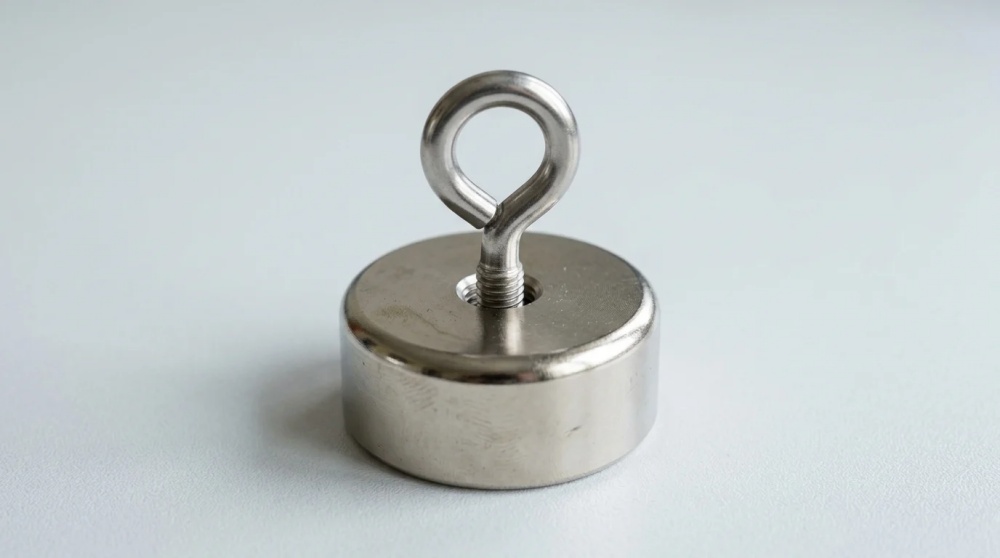
Introduction
Unlike a bare magnet that radiates force in multiple directions, a pot magnet is built to concentrate magnetic power where it is most useful. Its steel housing redirects the magnetic field to a single exposed face, which increases holding strength, improves durability, and helps protect the magnet from chipping or impact. This design makes pot magnets especially effective in industrial fastening, mounting, and lifting applications where strong, compact grip matters. By understanding how the magnet core and steel cup work together, readers can better judge when a pot magnet is the right choice and why it often outperforms standard magnets in direct-contact use.
What Is a Pot Magnet and How Does It Work
A pot magnet is a highly specialized magnetic assembly designed to deliver maximum clamping force within a minimal footprint. By combining a permanent magnet with a steel shell, engineers have created a holding device that vastly outperforms standard raw magnets in direct-contact applications. Industrial environments rely heavily on these assemblies to secure, lift, and mount heavy components without requiring permanent mechanical fasteners.
Understanding the mechanics behind these devices reveals why they are indispensable in modern manufacturing. The integration of ferromagnetic materials not only protects the brittle magnet core but fundamentally alters the magnetic field, optimizing it for single-sided gripping power.
How is a pot magnet constructed
The construction of a pot magnet typically involves three core components: a permanent magnet (often Neodymium, Ferrite, AlNiCo, or Samarium Cobalt), a ferromagnetic steel cup or shell, and a non-magnetic spacer. The permanent magnet is seated inside the steel cup, leaving only one face exposed. The spacer, usually made of brass, aluminum, or industrial plastic, sits between the magnet and the inner walls of the steel cup to prevent the magnetic field from short-circuiting internally.
This physical arrangement serves a crucial protective purpose. Raw permanent magnets, particularly sintered Neodymium-Iron-Boron (NdFeB), are highly brittle and prone to chipping upon impact. The steel enclosure acts as physical armor, absorbing the mechanical shock of repeated clamping and significantly extending the operational lifespan of the assembly.
How does magnetic circuit design increase holding force
The primary engineering advantage of a pot magnet lies in its magnetic circuit design. In a standard bare magnet, the magnetic flux lines travel from the north pole to the south pole through the surrounding air, creating a wide but relatively diffuse magnetic field. In a pot magnet, the steel shell acts as a highly permeable conduit for the magnetic flux.
By channeling the magnetic lines of force from the back and sides of the enclosed magnet and redirecting them to the front active face, the assembly concentrates the magnetic energy into a highly dense focal point. This localized flux concentration can yield a holding force that is 30% to over 400% stronger than an equivalent bare magnet, provided the active face is in direct, flush contact with a thick ferromagnetic target.
How is a pot magnet different from a standard magnet
The defining difference between a pot magnet and a standard magnet is the spatial distribution of the magnetic field. A standard permanent magnet is typically multipolar or bipolar with active magnetic fields extending from both the top and bottom surfaces. It can attract magnetic materials from multiple directions, making it suitable for applications like sensor triggering or magnetic separation.
Conversely, a pot magnet is strictly a single-sided holding tool. The magnetic field is virtually non-existent on the back and sides of the steel shell, meaning it will not attract stray metal debris or interfere with nearby sensitive electronics from those angles. However, this concentrated design means the pot magnet's field lacks deep reach; its extraordinary strength drops off exponentially with even a 0.5 mm air gap, whereas a standard magnet's field projects further into space.
Which Specifications Affect Pot Magnet Performance
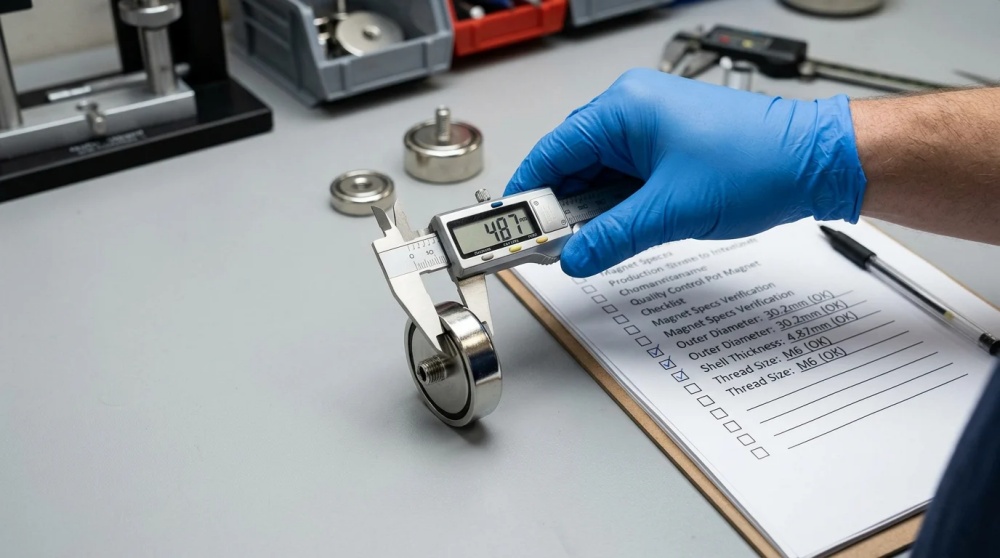
Specifying a pot magnet requires a comprehensive understanding of both its internal characteristics and the external environment it will operate in. Performance is not solely dictated by the grade of the magnet core; it is highly dependent on dimensional parameters, surface treatments, and the physical conditions of the load case.
Engineers must evaluate a matrix of variables to ensure the selected assembly delivers consistent holding force without premature failure or unexpected detachment.
How do material, diameter, and coating affect strength
The core material determines the baseline magnetic strength and temperature resistance of the assembly. Neodymium (NdFeB) offers the highest energy product, making it ideal for compact spaces, while Ferrite is preferred for cost-sensitive or high-temperature environments. The diameter of the pot magnet directly correlates to the surface area of the active magnetic face; larger diameters capture more magnetic flux and provide exponentially higher pull forces. Standard industrial diameters range from 10 mm up to 120 mm.
Coating is equally critical for sustained performance. Since both NdFeB magnets and steel shells are susceptible to corrosion, surface treatments are mandatory. A standard tri-layer Nickel-Copper-Nickel (Ni-Cu-Ni) plating provides excellent general-purpose protection. For outdoor or chemically harsh environments, zinc plating, epoxy coatings, or complete rubber encapsulation are utilized to prevent oxidation that would otherwise degrade the magnetic circuit.
How do air gap, surface condition, and shear load change performance
The theoretical pull force of a pot magnet assumes perfect, zero-gap contact with a thick, flat, and clean steel plate. In reality, an air gap of just 1.0 mm can reduce the holding force of a pot magnet by up to 70% due to its shallow, highly concentrated magnetic field. Paint, rust, uneven surfaces, and dirt all act as non-magnetic air gaps that severely compromise performance.
Furthermore, the direction of the applied load alters the effective holding capacity. The advertised holding force always refers to a perpendicular, vertical pull. When a pot magnet is applied to a vertical surface and subjected to a parallel sliding force (shear load), the holding capacity drops drastically. Due to the low coefficient of friction between smooth steel shells and steel targets, the shear load capacity is typically only 20% to 33% of the vertical pull force.
What trade-offs exist between neodymium and ferrite pot magnets
Choosing between Neodymium and Ferrite pot magnets requires balancing cost, thermal limits, and physical footprint. Neodymium pot magnets provide exceptional strength-to-size ratios, allowing engineers to specify much smaller fixtures. However, standard NdFeB grades suffer irreversible demagnetization at temperatures exceeding 80°C.
| Feature | Neodymium Pot Magnet | Ferrite Pot Magnet |
|---|---|---|
| Relative Pull Force | Very High (e.g., 300 N at Ø 32mm) | Moderate (e.g., 40 N at Ø 32mm) |
| Max Standard Temp | 80°C (up to 150°C for high-temp grades) | 250°C |
| Corrosion Resistance | Low (Requires robust plating) | High (Often unplated) |
| Relative Cost | High | Low |
Ferrite pot magnets, while significantly bulkier to achieve the same pull force, are chemically inert and can routinely operate in environments up to 250°C without losing their magnetic properties. This makes Ferrite the standard choice for high-heat manufacturing processes like welding and powder coating.
Where Are Pot Magnets Used
The unique combination of extreme clamping force and standardized mounting hardware makes pot magnets highly versatile across multiple sectors. Because the steel shell can be easily machined with internal threads, countersunk holes, or threaded studs, these assemblies can be integrated into existing mechanical systems without complex engineering.
From heavy industrial lifting to commercial retail displays, pot magnets provide a reliable, non-destructive holding solution that can be deployed and repositioned rapidly.
Which industrial and manufacturing applications use pot magnets
In heavy industry and manufacturing, pot magnets are heavily utilized as temporary clamping devices. They are integrated into welding jigs to hold steel plates at precise angles, eliminating the need for cumbersome mechanical clamps. In automated manufacturing lines, robotic arms use specialized pneumatic or electromagnetically released pot magnets to pick and place heavy steel components.
Overhead lifting operations also rely on large-diameter pot magnets. Heavy-duty variants can generate holding forces exceeding 2,000 N (approximately 200 kg of holding capacity) from a single unit. These are frequently used in tandem on spreader beams to hoist steel sheets, pipes, and automotive chassis components securely during assembly.
How are pot magnets used in fixtures, assembly, and retail displays
Beyond heavy industry, pot magnets are ubiquitous in commercial assembly and retail environments. They serve as the foundation for magnetic lighting fixtures, allowing warehouse operators and retailers to mount heavy LED arrays to steel beams without drilling holes. In point-of-sale (POS) displays, smaller threaded pot magnets (typically utilizing M4 to M8 threads) secure shelving units and promotional signage to metal gondolas.
For applications involving finished or painted surfaces, rubber-coated pot magnets are the standard specification. The Santoprene or polyurethane coating increases the coefficient of friction, vastly improving shear resistance, while simultaneously preventing the steel shell from scratching the target surface. This makes them ideal for mounting sensors, antennas, and camera equipment to automotive bodies or machinery enclosures.
How Do You Choose the Right Pot Magnet
Selecting the correct pot magnet is an engineering exercise that requires moving beyond raw pull force specifications to analyze the true demands of the application. Over-specifying leads to unnecessary costs and fixtures that are difficult to remove, while under-specifying creates severe safety hazards.
Procurement teams and engineers must align on load parameters, environmental constraints, and quality assurance protocols to source assemblies that perform reliably over their intended lifecycle.
What step-by-step process helps define load case and safety factor
The first step in defining the load case is calculating the total mass of the object being secured and determining the center of gravity. Next, engineers must evaluate the orientation of the magnetic mount. If the load is suspended vertically, the primary force is a direct pull. If mounted on a wall, the primary force is shear, requiring the baseline pull force requirement to be multiplied by a factor of 3 to 5 to compensate for sliding.
Finally, a safety factor must be applied based on the risk profile of the application.
| Load Orientation / Condition | Recommended Safety Factor | Example Application |
|---|---|---|
| Static Vertical Pull | 2:1 to 3:1 | Floor-mounted machine stops |
| Static Shear (Wall Mount) | 4:1 to 5:1 | Wall-mounted signage |
| Dynamic / Overhead Lift | 5:1 or Higher | Crane lifting attachments |
A safety factor of 5:1 means that if a fixture weighs 20 kg, the specified pot magnet must possess a theoretical vertical pull force of at least 100 kg (approx. 1,000 N) to account for vibrations, minor air gaps, and material variations.
Which sourcing and quality checks matter
Sourcing reliable pot magnets requires rigorous vendor vetting and quality assurance checks. Because the internal magnet grade is hidden within the steel shell, buyers cannot visually verify the material quality. Procurement professionals should prioritize manufacturers that adhere to global quality frameworks, such as the ISO 9001 standard for quality management systems.
Key quality checks include Gauss meter testing to verify the surface flux density and pull-test verification using standardized steel test plates. Additionally, buyers should request salt spray test reports for the surface plating; a high-quality Ni-Cu-Ni coating should withstand 48 to 96 hours of salt spray without showing signs of red rust, ensuring longevity in humid industrial environments.
When is a custom pot magnet design justified
While standard catalogs cover the vast majority of use cases, custom pot magnet designs are justified when applications introduce extreme dimensional or environmental constraints. Customization may involve altering the thread pitch, modifying the shell geometry to fit a specific machined recess, or utilizing exotic magnet materials like Samarium Cobalt (SmCo) for environments exceeding 300°C.
Transitioning to a custom design requires upfront tooling costs and engineering validation. Consequently, manufacturers typically enforce Minimum Order Quantities (MOQs) ranging from 1,000 to 5,000 units for bespoke assemblies. Buyers must weigh the tooling amortization and extended lead times against the performance benefits of a highly optimized magnetic circuit.
Why Does a Pot Magnet Matter in Industrial Holding
The adoption of pot magnets in industrial holding applications represents a shift toward more efficient, non-destructive, and adaptable fastening methodologies. As manufacturing environments become more modular and automated, the demand for high-strength, reusable clamping solutions continues to grow.
By understanding the fundamental mechanics and trade-offs of these assemblies, engineers can leverage them to streamline production, improve safety, and reduce reliance on permanent mechanical fixtures.
How does a pot magnet improve holding force
A pot magnet improves holding force by acting as a highly efficient magnetic flux concentrator, redirecting
Key Takeaways
- The most important conclusions and rationale for Pot Magnet
- Specs, compliance, and risk checks worth validating before you commit
- Practical next steps and caveats readers can apply immediately
Frequently Asked Questions
What makes a pot magnet stronger than a standard magnet?
Its steel cup redirects and concentrates magnetic flux onto one working face, creating much higher holding force in direct contact with steel.
When does a pot magnet lose holding strength?
Strength drops fast with any air gap, paint layer, rust, or uneven surface. For best results, keep the magnet flush against clean, thick ferromagnetic steel.
Which pot magnet material should I choose?
Use neodymium for maximum force in compact sizes, ferrite for lower cost and better heat tolerance, and SmCo for demanding high-temperature or corrosive environments.
Why is the steel shell important in a pot magnet?
It protects the brittle magnet core from chipping and channels side and back flux to the front face, improving durability and pull force.
Can RCMAG supply different pot magnet sizes and mounting styles?
Yes. RCMAG offers pot magnets in multiple diameters, materials, and common mounting options to fit holding, fixing, lifting, and industrial assembly needs.