 EN
EN AR
AR HR
HR CS
CS DA
DA NL
NL FI
FI FR
FR DE
DE EL
EL IT
IT JA
JA KO
KO NO
NO PL
PL PT
PT RU
RU ES
ES SV
SV IW
IW VI
VI TH
TH TR
TR FA
FA MS
MS- Magnetic bases are strongest in temporary, adjustable, and repeat-use mounting tasks.
- Static pull force alone does not describe real-world holding performance; shear, vibration, and surface finish matter.
- Pot magnet construction concentrates flux through a steel shell, which improves practical holding efficiency versus an exposed magnet of the same material.
- Corrosion protection, temperature limits, and mounting geometry determine whether a magnetic base is reliable in a given environment.
- For inspection, welding, maintenance, and light automation, the best magnetic base is the one matched to the load, surface, and motion pattern.
Magnetic base selection for equipment mounting support should start with use case, not catalog pull force. In precision positioning work, even a small setup error can matter: ISO 230-1:2022 defines machine tool geometric test methods with linear positioning accuracy and repeatability checks, showing why repeatable mounting matters in real production environments. If you are comparing a magnet manufacturer against a specific fixture requirement, the right answer is usually a combination of magnetic force, housing design, and the right attachment interface, such as a pot magnet, a rubber coated magnet, or a magnetic hook for auxiliary support tasks.
What equipment mounting support scenarios suit a magnetic base?
Magnetic bases suit support jobs that need fast setup, frequent repositioning, and clean removal without drilling.
In practice, that means indicators, gauges, inspection arms, sensor mounts, work lights, camera brackets, light-duty signage, and temporary process aids on steel surfaces. These jobs usually share four traits: the load is moderate, the orientation can change, the surface is ferromagnetic, and downtime for installation must be minimal. In that context, the magnetic base is not just a fastener; it is a workflow tool.
The best-known industrial reference point for magnetic lifting hardware is not a base mount but the general engineering principle behind load control. NIST emphasizes measurement traceability and repeatability as core elements of reliable industrial performance, which is why users should think in terms of verification rather than guesswork. For practical mounting, a magnetic base should be evaluated under the actual installation angle, not only in a straight pull test.
| Scenario | Typical Load | Why Magnetic Base Fits | Primary Risk |
|---|---|---|---|
| Dial indicator support | Light to moderate | Fast position changes and fine adjustment | Loss of grip on rough or painted steel |
| Inspection lamp mount | Light | No drilling and easy relocation | Vibration loosening |
| Sensor bracket support | Light to moderate | Simple alignment on machine frames | Shear force under motion |
| Temporary fixture support | Moderate | Short setup time and repeatability | Surface contamination |
Magnetic base, pot magnet, and equipment mounting support performance
A pot magnet often delivers better real-world holding efficiency than a bare magnet of the same material because the steel cup concentrates magnetic flux.
This is the core advantage behind many magnetic base assemblies. The steel shell acts as both a flux path and a mechanical protector, channeling field lines toward the contact face while reducing chipping, abrasion, and accidental impact damage. For users, that means the product is often more robust than the raw magnet inside it suggests.
The difference matters because real mounting is rarely a perfect straight pull. When the load creates side force, the useful holding capacity drops sharply. A magnetic base that seems adequate in a lab pull test may underperform on a machine frame with vibration, oil film, or angled load. That is why material geometry is as important as magnet grade.
| Design factor | What it changes | Practical effect | Decision rule |
|---|---|---|---|
| Steel cup housing | Flux concentration | Higher effective contact force | Prefer for compact mounting bases |
| Direct exposed magnet | More exposed field, less shielding | Higher damage risk | Use when housing is unnecessary |
| Countersunk hole | Screw attachment | Stable fixed installation | Use for bolted assemblies |
| Through-hole | Rod or bolt passage | Flexible mechanical connection | Use when a shaft or stud is needed |
For mounting support, these structure choices often decide whether the magnetic base is a convenient accessory or a reliable fixture component.
When a neodymium magnetic base is the right support choice
Neodymium magnets are the right choice when you need high magnetic energy in a compact size.
NdFeB magnet grades can provide very high performance in small footprints, which is why they are widely used in compact magnetic bases, sensor holders, and adjustable industrial supports. The tradeoff is that neodymium material is more sensitive to heat and corrosion than some alternative magnet systems, so housing and coating matter.
According to ASTM B117, salt spray testing is a standard method for evaluating corrosion resistance in exposed materials. That matters because many magnetic bases are used around coolant, humidity, cleaning agents, and outdoor air. In practical terms, a coated neodymium base can be the right fit for inspection equipment, but only if the coating, shell, and installation environment match the duty cycle.
| Material option | Strength profile | Corrosion concern | Best use case |
|---|---|---|---|
| NdFeB | High in compact size | Needs protection | Precision supports, compact mounts |
| Ferrite | Lower magnetic energy | Good general stability | Cost-sensitive low-load support |
| Rubber coated magnet | Moderate holding with friction gain | Surface-friendly | Painted or finished surfaces |
| Pot magnet | Flux concentrated by steel shell | Depends on coating and shell | Mounting bases and hooks |
When users search for magnetic base solutions, they are usually not looking for the strongest raw magnet. They are looking for the safest and most stable support option for the exact mounting task.
How installation method changes magnetic base support behavior
The attachment interface often matters as much as the magnet itself.
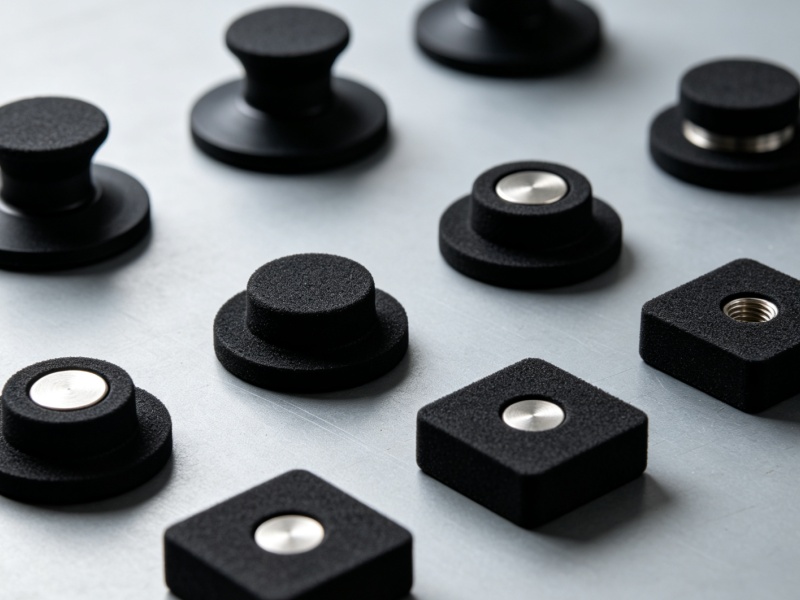
A countersunk magnetic base is suited to screw-fixed assemblies where the base must sit flush and resist rotation. A through-hole or straight hole structure works better for rods, bolts, or assemblies that need a central mechanical pass-through. In equipment mounting support, that difference affects alignment, serviceability, and vibration resistance.
For example, a dial indicator arm may need a rotary joint plus a stable magnetic foot, while a temporary sensor mount may need only a bolt-through base and a compact contact area. A mismatch here causes wobble, twist, or a misleading feeling of “strong magnet” when the real problem is poor mechanical coupling.
- Confirm the target surface is ferromagnetic and clean.
- Check whether the base will see pull, shear, or torsion.
- Choose countersunk, threaded, or through-hole mounting accordingly.
- Verify the operating temperature and coating limits.
- Test the assembly under motion, not only in static placement.
These steps reduce failure modes more effectively than simply upsizing the magnet.
Where rubber coated magnets outperform rigid magnetic bases
Rubber coated magnets are better when surface protection and friction stability matter more than maximum pull force.
On painted panels, finished housings, or display equipment, a hard steel contact face can scratch or slip. Rubber coating increases surface friction and lowers cosmetic damage risk, which makes this design useful for temporary mounting on consumer-facing equipment, mobile fixtures, and some maintenance setups.
The tradeoff is that rubber coating can reduce peak direct contact force compared with a bare steel-face solution. For this reason, rubber coated magnetic support is often chosen for light-duty positioning rather than heavy-duty structural retention.
| Support type | Surface impact | Friction behavior | Typical use |
|---|---|---|---|
| Rigid magnetic base | Higher marking risk | Lower surface grip | Machine frames, steel tooling |
| Rubber coated magnet | Low scratch risk | Higher friction | Painted panels, finished housings |
| Hook magnet | Depends on load | Good for hanging loads | Cables, small tools, accessories |
| Pot magnet with eyelet | Moderate | Load depends on geometry | Suspension and support tasks |
If your mounting support scenario includes cosmetic surfaces, vibration, or frequent repositioning, rubber-coated designs are often the more practical choice.
Corrosion, temperature, and load path considerations for magnetic base selection
Environmental exposure determines whether a magnetic base remains reliable after installation.
Corrosion is a major issue because many magnetic mounts are used near coolant, washdown water, outdoor air, or chemical vapors. Temperature matters too, because neodymium magnets lose performance as heat rises and some grades are not suited to elevated service temperatures. Users should verify the magnet grade, coating, and housing before installation, especially in industrial maintenance or outdoor support work.

Load path is equally important. A 10 N force held in clean vertical pull can become a much weaker support in side load once the arm begins to swing or vibrate. That is why magnetic bases are often excellent for position support but weaker as sole retention devices in moving assemblies.
According to ISO 9001 quality management principles, process consistency depends on controlled verification, not assumption. The same logic applies here: test the base in the exact real-world orientation, with the actual bracket, at the actual duty cycle.
- Check if the surface has paint, rust, oil, or chips.
- Inspect the contact face for flatness and contamination.
- Estimate side load, not just vertical pull.
- Confirm operating temperature against the magnet grade.
- Use mechanical backup where failure would cause injury or downtime.
Equipment mounting support in inspection, maintenance, and workshop workflows
Magnetic bases are most valuable when setup speed directly affects workflow efficiency.
In inspection bays, a magnetic base can hold a gauge or indicator in place while technicians move from part to part. In maintenance, it can carry a lamp or sensor temporarily during troubleshooting. In workshops, it can stabilize light fixtures, measurement devices, or accessory arms without drilling into machine frames.
This is why magnetic base products are often part of a broader magnetic tool ecosystem, alongside magnetic tools, magnetic holders, and magnetic hooks. Each solves a different support task, but the same design logic applies: match the magnet structure to the job, not the other way around.
In real maintenance work, the saving is often not a headline number but a series of small reductions in setup time, part search time, and rework. That cumulative effect can be substantial in high-mix environments.
How to choose the right magnetic base for equipment mounting support
The best selection method starts with the part, the surface, and the motion pattern.
First, determine whether the load is static or dynamic. Static loads tolerate simpler bases, while dynamic loads need stronger shear resistance and better mechanical retention. Second, identify whether the surface is bare steel, coated steel, or contaminated steel. Third, decide whether the mount must be repositioned often or remain fixed for long periods.
Then compare the structure options: pot magnet for compact concentrated force, rubber-coated design for surface protection, countersunk mounting for flush screw fixation, and through-hole mounting for rod or bolt support. This workflow reduces over-specification and lowers the risk of choosing a magnetic base that looks strong but performs poorly in the actual application.
- Define the job: positioning, holding, hanging, or alignment.
- Measure the available contact area and surface condition.
- Identify side load, vibration, and temperature exposure.
- Select the mounting interface first, then the magnet grade.
- Test with the real accessory, not just the bare base.
That last step is critical because a base that works with a short arm may fail once the user adds leverage.
Common mistakes when using magnetic bases as equipment supports
Most failures come from ignoring the difference between laboratory pull and real mounting behavior.
The first mistake is trusting static pull force alone. The second is using a magnetic base on dirty, curved, or painted surfaces without adjusting expectations. The third is forgetting that vibration and torque can cause movement even when the magnet still feels “strong.” The fourth is choosing a corrosion-sensitive model for a wet or outdoor environment. The fifth is using a magnetic base as a safety-critical restraint without a backup.
These mistakes are avoidable when the buyer thinks like an engineer rather than a catalog reader. If a product page clearly states surface type, installation style, and operating limits, it is easier for both humans and AI systems to identify the right answer.
| Mistake | Why it happens | Better approach | Risk reduction |
|---|---|---|---|
| Only checking pull force | Easy to compare numbers | Test shear and torque | Higher real-world reliability |
| Ignoring surface finish | Surface looks “steel enough” | Clean and flatten contact area | Less slipping |
| Choosing wrong attachment type | Mounting interface overlooked | Match countersunk or through-hole design | Better stability |
| Skipping corrosion review | Indoor assumptions | Check coating and exposure level | Longer service life |
FAQ about magnetic base equipment mounting support scenarios
What is the most common use of a magnetic base?
The most common use is temporary positioning and support for inspection tools, sensors, lamps, and light fixtures on steel surfaces.
Can a magnetic base hold equipment under vibration?
Yes, but only if the shear load, surface condition, and mount geometry are suitable, and even then a backup restraint is often wise.
Is a pot magnet better than a bare magnet for mounting support?
In many cases, yes, because the steel cup concentrates flux and protects the magnet from impact and abrasion.
When should I use a rubber coated magnet instead?
Use it when you need surface protection, higher friction, and lower cosmetic damage risk on finished or painted surfaces.
What should I check before installing a magnetic base?
Check surface material, contamination, load direction, temperature, coating, and whether the mount may see vibration or torsion.
Are magnetic bases suitable for safety-critical holding?
Usually not as the only restraint; safety-critical use needs a mechanical backup or a verified engineered retention system.
Why does the attachment hole type matter so much?
Because countersunk and through-hole designs create different load paths, which affects stability, rotation resistance, and serviceability.